Showing posts with label book review. Show all posts

Wednesday, October 26, 2016

The Great Derangement: Climate Change and the Unthinkable by Amitav Ghosh

There are very few books that fill you with a sense of urgency to write something on them before it’s too late. Amitav Ghosh’s The Great Derangement: Climate Change and the Unthinkable, which marks the author’s return to nonfiction after a long while, is one such book. The Great Derangement…delves into history (literary and political), analyses contemporary practices, our choices and preferences...and tells us how they are collectively responsible for forcing the nature to unleash destructive forces - like earth swallowing floods, monstrous earth quakes, gales with never-heard-of speed and ferocity – and have brought us to the edge from where a return journey is not possible unless we immediately stop the ‘march of modernity’.  

The book blames several things for the climate challenges we are faced with – one is history, another is indifference of serious fiction towards climactic matters, another is the apathy of governments to climactic concerns, still another is our lack of awareness about the havoc climate change can wreak in our lives although there is no dearth of evidence around us.

Ghosh is most morbid about the middle class when it comes to suffering from impact of climate change. He says the rich will fly away in airplanes, the poor will go away to their villages, but where will the middle class go given the fact that they have built their lives in cities? In other words, Ghosh says cities are most vulnerable to the effects of climate change.

And particularly those that are close to sea or other forms of water bodies, like Mumbai, Hong Kong, Singapore, Calcutta. Most of these cities were built in colonial period to act as good trade and commerce centers because of their proximity to water. And somehow this preference for proximity with water has crept into the elites of these cities, who tend to build their settlements close to water. The richer the closer.

This love of the rich for staying close to water makes the sea-facing locations most coveted real estate pieces. And, Ghosh observes, this desirability of these locations as real estate properties, anywhere around the world, makes it difficult for governments (or municipal bodies) to create awareness about the perils of staying close to water bodies, thanks to the political clout the real estate practitioners enjoy everywhere.  

For Ghosh the peril of this proximity was best exemplified when he travelled to Andaman and Nicobar islands to report on the impact of tsunami.  He visited an army settlement located close to the sea. He noticed two things: a) the higher the rank of the occupant, the closer his dwelling was to the sea leading to the highest rank holder staying closest to the sea (and vice versa); b) those closest to the sea were affected the most by tsunami.

Ghosh observes that in the pre-colonial period people lived away from water, but with the city-building projects the colonial masters took up, the preference slowly reversed.

One of the most original points Ghosh makes in Derangement is the indifference of literary fiction to the concerns of climate change. According to Ghosh, some of the practitioners of serious fiction in the 19th century consciously moved away from using fantastical elements – like flying carpets or a rising sea gulping a landscape – as a means to tell stories, in order to focus on more prosaic day-to-day affairs of life. This prosaic-ity fulfilled the requirements of serious fiction. So describing minor details of landscape and how people lived their lives became fashionable. Amitav Ghosh says this shift from writing about fantastical occurrences to more mundane motions of life had to do with the emphasis of the Industrial Revolution on betterment of human lives.

This shift made the fury of nature, like floods, cyclones etc., an untouchable terrain for serous fiction – because, as Ghosh observes, the gigantic scale of these furies of nature lends them a fantasy-like incredulity not to be dealt with in the type of fiction which swears by credulity.  

Writing on furies of nature fell to less-respected a form of fiction, genre fiction. And, Ghosh rues, it continues to this day. That is why thrillers and science fiction have addressed climactic concerns; but sadly, the author says, because genre fictions hardly receive any serious literary award, the issues they address don’t receive the attention they deserve.

One of the things responsible for pushing us to the brink is replacement of coal with petrol as a fuel. Petrol is a more versatile fuel than coal but that is not the only thing which explains why petrol usurped coal’s position as a primary fuel: the reason is petrol is a politically safer fuel than coal – and what makes coal a politically volatile fuel is the highly visible mining process involved in it unlike the refinement process of petrol which is very opaque.

Remember the blackened face of the 20th century coal miner melancholically looking at you from a black and white photo? This visibility of the plight of coal miners is responsible for the revolutions that coal mining has led to unlike the plight of petroleum refinery workers which suffers in obscurity. And the political elite of the Anglosphere the Churchills and Roosevelts of this world knew about this disadvantage of coal mining, Europe having experienced many of the coal-triggered revolutions, and ensured that coal was replaced by petroleum as a primary fuel.

But as always Ghosh’s favorite whipping horse is once again colonialism. He says Britain made sure that the benefits of the industrial revolution were denied to its colonies – and that’s the kind of development that took place in the Western world didn’t take start in Asia until the 1950s when the colonies started getting independence. But, according to the author, the earth can’t withstand the rigor of another round of Western-style development.

That’s why, in climate negotiations taking place among nations, the Western nations insist the poorer nations to take a different route to development.

Ghosh says governments across the world, particularly the democratic ones, come to power on the promise of fulfilling people’s aspirations – and therefore are ill-placed to ask their citizenry to view their actions in the light of their moral responsibility towards saving the earth from going over the edge. It’s only religious groups that can do that. And Ghosh praises the book Laudato Si written by pope Francis in this regard and does a comparative study between the papal book on climate and another important treatise concerning the same subject, The Paris Agreement - and concludes that Laudato Si is much more lucid and readable of the two.

You can take The Great Derangement in many ways – as a book which preaches, prophesises, disparages - by asking us to happily forgo the type of modern development the Western nations have taken for granted. And I am afraid seeing the book in any of these ways will obscure you to its merit as a well-researched book which forcefully holds a brief for climate and makes some unique points along the way. But it does so not without occasionally sliding into ideological slots avoiding which would have ensured a wider acceptability of its views which are certainly worthy of attention.

Tuesday, September 20, 2016

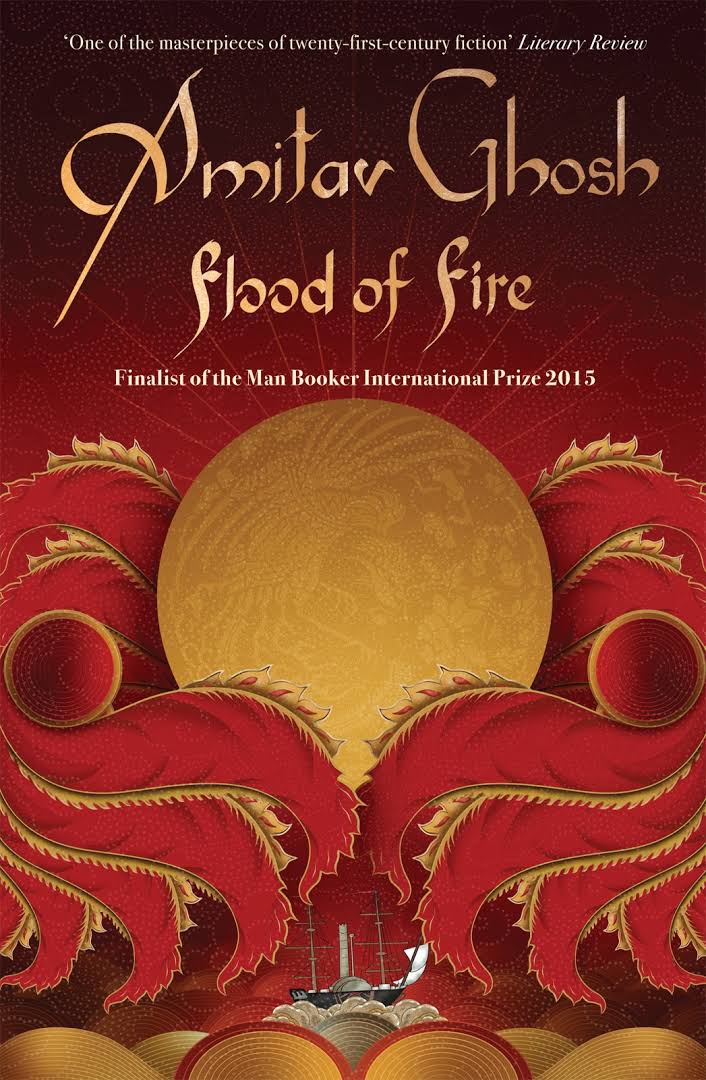
Flood of Fire by Amitav Ghosh

I have read several trilogies but with almost all of their later versions in the series I got the feeling that the narrative had run out of steam, that there was hardly a second or a third installment and one was made only to capitalize on the success of the earlier books. Amitav Ghosh’s Flood of Fire, the third and final book in the Ibis trilogy, which started about seven to eight years back with Sea of Poppies, never made me feel the same way.

The first two books in the series deal with the period leading to the Opium War and the third one – Flood of Fire – with the war. The Chinese authorities alarmed at the damage opium has caused to the youth of the country has decided to stamp out the British merchants dealing in opium from its shores little knowing that about a year or two later the merchants will manage to get the British government to invade China to force opium back on the Middle Kingdom.

And when the invasion comes the Chinese find themselves ill prepared to face the might of British attack. The period leading to the onset of war is revealing in many ways. The man responsible for upsetting the apple cart of opium trade, Commissioner Lin, an upright and incorruptible high official sent in by the Chinese authorities to deal with the menace of opium, is abruptly removed from his position under fabricated charges of foul play and replaced by his deputy, a pliable man, who is also awarded the responsibility to conduct an inquiry into Commissioner Lin’s wrong doing. 

What a humiliation! But what is the actual reason for Commissioner Lin’s ouster? The British opium merchants had petitioned the local Emperor that Mr Lin had been obstructing free trade (by preventing them from carrying on their opium trade). Defense of free trade, free will, God's will etc are the ruses used by the British to justify the campaign of war. This is the larger point behind Ghosh’s trilogy: unsavory means imperialism uses for its sustenance and expansion. 

Ghosh had turned down the Common Wealth Prize because, as he later said in an interview, it’s a commemoration of the Empire. Ghosh is one of those writers whose subjects change but the central muse remains the same. Take any of his works, and you can trace it back to the effects of imperialism, which includes his latest nonfiction offering – The Great Derangement – where he has blamed imperialism (or its less extreme version capitalism) for the environmental challenges we are faced with.

Despite this larger theme in the background, however, Ghosh has dealt with his character and events with an ideological detachment, just narrating the events as a raconteur avoiding getting self-righteous about anything. As a result, the opium merchants come across not as evil souls but men of their times using a business opportunity.

Almost all significant characters have been carried forward from the second installment – River of Smoke – and some are a continuity of the first. Ghosh has brought them and their related sub plots (and there are many of them) to conclusive end in Flood of Fire. In doing so, however, he has sometimes tried too hard, reading a little contrived in the process.

He has put three important characters to death because their prospects beyond the plot were not too bright or clear. He has made two characters - who had existed in the second version but hadn’t met - fall in love and marry because there was no other visible possibility arising out of their meeting. Many characters which had been given a short shrift in the first and second installments have found sizable space in Flood of Fire.

But that hardly takes away from Ghosh’s strength of characterization. In fact, Ghosh has established his characters with his readers so well that it took me only one or two introductory sentences to recall them upon their first appearance in this edition. 

Neel a scion of a feudal family who started off as a debauch in Sea of Poppies and is arrested for being a defaulter goes through a range of experiences in China where he had ended up after fleeing the ship – the Ibis – which was transporting him to Mauritius to be an indentured laborer – completely redeems himself. Zachary a poor but personable American sailor, in the first book, becomes a wealthy businessman in the last. Aaa Fatt an opium addict and a love child of a successful opium merchant gets killed by a mafia don who had started looking for him in River of Smoke – the second book in the trilogy - to avenge the fact that Aaa Fatt had seduced his lover. And like them there are other characters too whose lives are transformed in the course of the trilogy.

Flood of Fire is not bad but the second one of the pack – River of Smoke – is the best of the three books, with its unhurried and intricate narrative without any attempt to be a thriller.   

Friday, August 26, 2016

Greatest Bengali Stories Ever Told - a Collection of Bengali Short Stories

A collection of short stories written by writers writing in the same language and coming from the same place can often cover the past and present of a place more widely than it is possible for a novel which, even those moving back and forth in time to cover a long period, mostly takes a linier trajectory. 

The Greatest Bengali Stories Ever Told translated by Arunava Sinha do something similar: the collection brings together the work of the most famous and not so famous Bengali writers coming from different periods and places of Bengal and covering a huge landscape from Bengal’s past and present.

Alas, it is hard to understand whether it is by design or accident. Sinha informs us, in the introduction, that his choice of stories isn’t based on any scholarly or thematic consideration; instead on what he considers best stories or stories he has been able to place himself.  On a more informative note, he informs us that Bengali short stories can’t be traced to any particular period or group of practitioners of the form; they were always being written; they were always there, evolving with time.

The first story in the collection is Rabindra Nath Tagore’s famous Kabuliwallah. Having seen its movie adaptations, which were lengthened by songs, I felt the story ended too soon, although it  read surprisingly fresh.  Mahesh, by Sarat Chandra Chattopadhyay, tells the story of a Muslim man who owns a cow called Mahesh and takes care of the animal with fatherly affection and care. One day, due to Mahesh, misfortune visits him and enraged he hits Mahesh on its head killing the animal. The village turns against him accusing him of cow slaughter. It was written around a century back.

Einstein and Indubala deals with our preference for entertainment over scholarship. Einstein visits a small town to deliver a lecture. On the day the lecture is scheduled, there is another event in the town which everyone is awaiting: a live performance by Indubala, a cine sensation.  When Einstein arrives at the lecture venue he finds all the seats empty. 

The guard informs him that everyone would have gone to watch Indubala perform.  Finally the scientist goes to the place and finds the organizers of his lecture sitting there. Bibhutibhushan Bandyopadhyay had written it based on a report he had read in a newspaper.

I found Sunil Gangopadhay’s Post Mortem too incoherent. It reminded me of what the writer had once told about writing short stories. In his initial days as a writer he was reluctant to try out short stories, until a friend told him one day that writing short stories was easy: write what you do in a day, from the time you get up to the time you go to bed, and stop somewhere, and you have a short story.

Swapan is Dead, Long Live Swapan by Udayan Ghosh deals with Naxalism, the only story in the collection to deal with the socio-political issue which had rocked Bengal in the 70s. I also liked Mahaswtha Devi’s Urvashi and Johnny which is about people who call streets their home. There are a few more in the collection.

The literary merit of the stories notwithstanding, the book’s title -The Greatest Bengali Stories Ever Told - could be a little more understated as also the title of its introduction where Sinha justifies putting together the collection – My Love Affair with Bengali Stories.

Tuesday, June 21, 2016

Gachar Gochar - the Problems Wealth Brings

Usually we blame our problems on lack of wealth. Gachar Gochar, written by Vivek Shanbhag in Kannada and translated into English by Srinath Perur argues the opposite: wealth brings problems it its wake. Gachar Gohchar manages to make its point very succinctly, in only 115 pages through the story of a Kannada family which goes from lower middle class existence to prosperity following the success of a spice business the family starts with the corpus received from the forced voluntary retirement of its sole earning member.

The narrator, a member of the family, takes you through how the family gradually loses its coherence as wealth comes in. The spontaneous family gatherings stop, the dependence on each other goes, minor differences which had found scant attention earlier start developing into prominent fissures, some of its members scuttle their responsibilities and settle for easier choices money and power can provide; gradually middle class values, which had held the family together earlier,  erode. The narrator makes timely interventions stepping back from the story and giving observations on the happenings to press home the point: that it’s the new entrant money which is behind the changing complexion of the family.

Despite the seriousness of the topic, Shanbhag manages to make you laugh for most part of the book with situations that are common to all middle class joint families. But what impresses you the most is the rootedness of Gachar Gochar into the world that it belongs to. 

Vivek has captured the idiosyncrasies of a middle class family excellently through their day-to-day habits and practices, like a discussion started at the dinner table far outlasting the food and the family members hearing engrossed even as the remnants of the food is caking up on their fingers or a member absent-mindedly picking up grains of rice from his plate and putting them in his mouth one by one as he his listening to what’s being told.

The story is inconclusive, in that the family doesn’t lose the acquired wealth and return to poverty; but towards the end, a sudden outburst by the narrator’s wife, Anita, the only daughter of a professor, and ill at ease in the atmosphere of new money that is her husband’s family, against the patriarch of the family (Chikkappa) who takes care of the spice business and whose authority in the family never suffers a dissent - throws the faultlines into sharp focus: that new money also creates a certain power structure of which others live and to ensure continuity of their vested interests they avoid challenging it, however unscrupulous be its way of ensuring that continuity.  

Following the outburst by Anitha the suffocating silence maintained by the family members on Chikkappa is broken – and in a throwback to the old times, the family gets together again around Chikkappa to hear his stories.


The end is like outpouring of rain following a parched day. Gachar Gochar is another example of the gold mine that is our vernacular literature. 

Wednesday, April 13, 2016

Bazaar of Bad Dreams by Stephen King

The Bazaar of Bad Dreams is my first exposure to Stephen King’s fiction. But not my first exposure to his writing – I read his ‘Stephen King on Writing’ some years ago where he advocates a workmanlike attitude to writing instead of an esoteric approach the other books I had read on writing and related subjects had advised. Does a writer stands stripped before his reader if he reveals the tricks and methods he employs to spin his yarns? Well, King, among the most successful authors in America, doesn’t think so.

The Bazaar of Bad Dreams, a collection of short stories King has written over a period of time and some poems, marks a re-manifestation of that belief. Every short story - some of them are sometimes not exactly short running into enough number of pages to be a novella - is preceded by an author’s note on the source of inspiration of the following story and sometimes the author’s reflection on the subject the stories are based on. I found these notes very interesting and truth be told sometimes more interesting than the stories. He explains how an incomplete idea, a rough idea, even a thought string - has the potential to be developed into a full-fledged story.  

Some of the gems are. An idea can sometimes remain in the depth of an attic (of your mind) and requires retrieving from there. Another is an idea sometimes come as a cup without its accompanying handle – and the handle can come to you from the most unlikeliest of situations without any outward appearance of being the missing handle to the cup. 

Once, when King was shopping in a departmental store, he was approached by an elderly woman who asked him why he didn’t write stories like Shawshank Redemption. When King said Shawshank Redemption was written by him, the woman refused to believe. Fame can be so limiting!

One of the stated purposes of the book is to show that King’s quiver of creativity has more variety to offer his readers than scary stories to which King owes his fame as a writer. I agree King can offer much more than ghost stories, which is quite evident from the stories, but almost all the stories show a tendency to return to King’s familiar turf: horror, some subtle, some a little gross, but horror. But of course, they have a lot else to them than that.

None of the stories is bald horror. They have properly developed characters with their world explained in detail. And horror is not a persistent theme with most of them. In some of them it’s just a ruse to end a story. In some horror is a plot possibility King slowly builds up towards.  And even those with the express intent to scare have an interesting body of narrative which works without the smattering of horror moments.

Wednesday, March 26, 2014

Midnight's Children - an experience

About 12 years ago, I had bought a pirated copy of Midnight’s Children while strolling in Dalhousie, in Calcutta, and 20 pages into the novel I had lost track of the plot (too many things were happening and the narrative timeframe was shifting back and forth too much and too fast).

I still continued reading only to give up 30 to 40 pages later. In early 2013, I read Anton Joseph, Rushdie’s memoir, where Rushdie extensively described the making of Midnight’s Children, starting from conceptualization to finish. The process had taken four years.

The idea for Midnight’s Children had come to Rushdie in bits and pieces. And once the bits and pieces crystallized into a concrete idea, he knew he had a novel, one whose setting would be India, his homeland which he had left as a child to go to England for studies but where his cultural roots still lay. But India is no England. It’s a country which is not just geographically vast but also diverse in every possible sense.

To taste its soil in all its complexities and diversities, Rushdie decided to come to India and crisscross the country as a low-budget tourist. After he returned to England, he left his full time advertising job to begin work on Midnight’s Children. Four years and some months later, this novel hurled him into the world of literary stardom.

The reason why I brought up Rushdie’s India tour is that it’s the key to my Midnight’s Children experience. The plot seems to join all the dots that together form the map of India also taking Pakistan and Bangladesh (in other words, the entire subcontinent) into its whirlwind narrative. At another level, the book is a deep and rich experience of India, to the extent that it can be safely called an India book, above everything else. (Rushdie has, in fact, called it his love letter to India.) Through the use of language, imagery, anecdotes, mythology, history, lives of common people and those not so common, it creates a complete image of the country reflecting all its characteristics.

MC is also a piece of stupendous story telling including three generations of a family, some 80 years in the life of a country (India – starting from 1920 to 1981). However, it’s on 15th August 1947 that the story takes its most significant turn with the birth of Saleem Senai. (How Rushdie has mingled fiction with history - Saleem is being born and the coming of independence marked by celebration on streets by people and Nehru's momentous speech - is legendary and something for writers to learn from.) From here on, the plot traces the life of Saleem Senai together with the life of its co-born, India, with the paths of the twins crisscrossing several times over as the two move through their formative years through triumphs and disasters. 

But enroute to adulthood, Saleem's life takes him to Pakistan and from there to Bangladesh where he is witness to and participants in their histories (some military coups and the 1971 war) and then returns to India to go through the travails of Emergency. (The story ends vaguely in 1979.)

In the narrative, Jawaharlal Nehru, Indira Gandhi, Bhutto, Mujibur Rehman share space with commandeering grandmoms with speech quirks, philandering husbands, conspiring aunts etc. It makes the canvas not only vast but also deliciously varied.

In the foreword, Rushdie has acknowledged his debt to Dickens and that’s one thing that any keen observer will notice almost throughout the book – its similarity with Dickensian milieu: in situations, characters and the overall canvas – all of them have a dramatic and larger than life character to them. 

Almost all the characters have some idiosyncratic trait (either in appearance or behavior or speech) which makes them endearing and enduring, both within the plot and beyond. In almost all situations, you will find drama and theatrics of the kind that we have come to associate with Dickens.

The canvas, characters, the language, as also its success (two Bookers), Midnight’s Children is every bit a grand affair. And reading it was a special experience.

Friday, November 8, 2013

The Professional by Ashok Ferrey

England is in news for an immigration issue where it is considering a law which would require those from a select group of countries (including India) to furnish 3000 pound as refundable bond as a warranty against overstay of visa period. Thankfully it has been dropped now. But the fact that the British government insisted on it suggests that England has long dealt with the immigration problem. (Alas, all big countries have but have reacted more soberly to it.)

That was the reason why I picked up The Professional (by Ashok Ferry): it promised a story about the immigrant experience in England not set in recent times but in the 80s. But that’s okay with me.

The Professional involves a narrative form I have come to like - where the narrative moves back and forth in time to cover a character’s past and present, with the past quietly explaining the reader what led to his present circumstances. The Professional narrates the story of Chamath seen through his older self 35 years later. Chamath, an Oxford alumnus, has applied for his residency permit and he is banned to work until he gets it.

And the only option to earn a living is the unorganized sector. In the meantime, Chamath’s father sends him a letter from Srilanka expressing his inability to send Chamath money and asking him to let out their flat in London which was bought some time back. Chamath finds an employment at a construction site where one day he is approached by two men who promise him good money for very little work. And thus starts Chamath’s dual life: a male escort in the evening and a construction site worker in the morning. His life in the evening takes him to people seeking company and pleasure and finally brings him to a couple who become his friends and benefactors.  

The Professional moves back and forth in time effortlessly and describes the world of a young Chamath, in London, and old, in Srilanka, quite well. It shows both sides of the immigrant experience: how is it for an immigrant to stay without a permanent resident status and the sacrifices parents make to send and educate their children abroad.

On the downside, however, the book moves from one narrative method to another without sometimes any change in content style to indicate the digression. Another thing that disappointed is that it documents the immigrant experience well, telling its highs and lows. But its synopsis promises more. The synopsis says the book would take you through the Thatcher years, England’s years of greed, as the synopsis puts it. 

But the story says very little about those years. The book informs that Chamath met with some prosperity as a real estate agent in later years which coincided with Thatcher rule and leaves it at that without detailing those years.


Detailing how he moved to prosperity would have been a good way to end the story on a more conclusive note; instead, the story ends Chamath’s England stay abruptly and later, in an epilogic fashion, informs what Chamath did in his later years in England, that he became a prosperous real estate person. It was my first book by a Srilankan writer and I liked it generally.

Monday, September 2, 2013

Chowringhee - romantic nostalgia of 60s Calcutta

When I saw the English translation of Shankar’s Chowringhee for the first time, it reminded me of another book I had read long years back on the same topic – Arthur Hailey’s Hotel. However, many years later, in fact a few weeks back, when I started reading Shankar’s Chowringhee, I found it very different from Hailey’s Hotel – in fact, the two share almost nothing except a broad topicality in common: hotel. Hailey’s Hotel had a particular plot whose setting was a hotel. Shankar’s is about life in a hotel.

Chowringhee is the second book of Shankar and a linear sequel to his first novel, The Great Unknown (the English translation of Koto Ojana Re). The book starts where the previous one had got over and the plot progresses into its central setting – Shahajahan Hotel – as the narrator – the young boy who worked as a court clerk under a British barrister in TGU – finds an employment in the hotel (on Chowringhee Road where the book gets its title from) by a quirk of fate.

And a range of characters flits in and out of the novel, taking the reader through various sides of life in a hotel. I found some similarities as well as dissimilarities with his The Great Unknown. Like The Great Unknown, Chowringhee also is told through the eyes of a wonderstruck kid who has found himself in a world which is awe-inspiring and beyond the scope and span of anything he has seen so far, especially coming as he does from a small town of Bengal.

The other similarity is that it’s just recording of life and experience in a workplace. Still another one is sentimentality – and there is a lot of it. You will also find flat characters in both of them. But the difference I noticed is that in Chowringhee Shankar has successfully brought in strokes of humor – and some of them are really funny, unlike TGU which was arresting but dour.

But despite these apparent shortcomings – expect humor – why did I read Mani Shankar Mukherjee again? For various things. The first book had left me moved despite these deficiencies – its characters and settings and recreation of the Calcutta of yore had left me yearning for a similar experience again. And Chowringhee recreated that experience for me.

The characters and their travails everything coalesces to form a moving experience – that’s what kept me interested in the book. The book shot to success after its publication (in 1962, predating Hailey’s Hotel by three years) and was turned into a movie by the same name.

Tuesday, May 7, 2013

The Skinning Tree by Srikumar Sen

Those of us who have not been to boarding schools don’t understand how difficult life for a kid can be there. Apart from a few difficult situations, however, Sabby Sarkar doesn’t face too many challenges coming from his peers. But that doesn’t make Sabby’s experience at his boarding school at Gaddi pleasant. The Skinning Tree is the first book by Srikumar Sen (now 81). The novel starts in the Calcutta of the 40s and 50s where Sabby is growing up in an aristocratic Anglophone Bengali family.


Sen brings alive the Calcutta of the period effectively and successfully creates the political and social atmosphere of the time. Through the Sarkar household, Sen has brought about the duality of the world aristocratic-Anglophone Indians inhabited those days, one that included their British social equals cohabiting with their loyalty to India and sympathy for the Independence movement.

However, Sabby’s Calcutta world abruptly comes to an end when he is sent to a boarding school and finds himself in a completely different world. Of the most remarkable things at the school is the fearsome atmosphere created by discipline-enforcing sisters and brothers at the boarding. Every boy who strays from the straight line of discipline faces punishment, spanking of various degrees of severity depending on how far away you strayed.

Another hallmark of Sabby’s experience at the boarding is the numerous acts of cruelty the students carry out towards animals. This is where the book draws its title from – there is a tree outside the boarding premises on which the students throw out skinned bodies of birds and animals after sadistically killing them. Initially a little reluctant, Sabby eventually joins his boarding friends in their acts of cruelty. I felt cruelty towards animals was a manifestation of the pent up feelings caused by oppression at the boarding – cruelty inflicted on one person finds its way to another, maybe in a different form.

However, this cruelty-towards-animal part of the book can read a little unsavory. The details of torture of insects, birds are too graphic and sensitive souls will find it difficult wading through them. The book also becomes a little monotonous while the author takes you through the butchery of one animal after another by Sabby and friends. The book takes a sudden turn towards the end when a tragedy occurs.

One day Sabby finds a sister, a very authoritarian figure in the boarding, calling out to him for help standing on a ledge a fall from where would surely lead to death. At the same time, it is time for Sabby and the other boys to attend a prayer. The prayer bell has rung and heeding the sister’s call for rescue would mean reaching the prayer late and attracting punishment from one of the brothers. Sabby stops upon hearing the sister’s call for help, but as he sees his friends rush for the prayer, he follows them. Next day they find the sister’s dead body lying on the ground below the ledge.

And even after many years a contrite lingers in him. Sabby wonders should he have tried to help the sister, but wouldn’t he get late for the prayer then attracting punishment? Even if he tried to save the sister, would he, just a child, be able to really save her? He could have called others' attention to the incident, but who would listen making a dash as they were for the prayer? Or was it that when he saw the sister in a helpless situation calling out to a mere boy for help, Sabby found it hard to believe that a person of such command and authority as the sister could be so helpless – the prayer bell seemed more believable and he ran for it?

The very atmosphere of oppression and fear-psychosis which the sister had helped build finally took her life. To me The Skinning Tree is a strong indictment of the boarding life where punishment (and fear of punishment) is used as a means to enforce discipline.

After this incident Sabby visited home and never went back to the boarding.

The book has won the Tebor Jones South Asian Prize.

Friday, March 22, 2013

Merry Go Round - W Somerset Maugham

The best part about reading novels set in the Edwardian period, in England, is that that society resembles the Indian society in many ways. A rigid moral code defying which meant attracting collective social frown; the existence of a strict class division, violating which led to social derision and people going about their lives under these social norms , sometimes digressing but most times conforming. Merry Go Round was my third Maugham novel and it shares many traits in common with the other Maugham novels I read before, like character examination, a slow build up, adultery etc.

But the book is also different from the other two I had read in various ways. Merry Go Round is a commentary on the Edwardian society: how social rules shaped the lives of people, how a rigid class division was maintained, the shallowness of all this etc.

The narrative has several strands. Merry Go Round starts with a house party and then pans out into a novel tracking the lives of the guests at the party. The host of the party, Miss Ley, is a spinster who has inherited a fortune from another spinster and is the moral axis around which the other characters in the novel revolve.

There is Basil Kant an aspiring writer who marries a barmaid because of an unexpected development, overlooking his feelings for Mrs Murray - and the marriage suffers. There is Herbert Field, a clerk and poet, who is suffering from tuberculosis and Bella Langton at 40 double the age of Herbert marries him to tend to him in his last days and sees the poet die. And there is Frank Hurrell, a cynic, who abhors the conventional life. And there are many more to bring about a complete social interplay of characters, some conformists and some rebellious.

Maugham has skillfully pitted the rebellious characters against the conformist ones to throw into sharp relief his voice and views against those of the Edwardian society. The book mainly cocks a snook at the rich the employing class which held people economically dependent on them to the very moral codes that their socials peers and companions violated.

In another review of a Maugham book, I had said that his observations on human character and other things form an important part of Maugham’s narrative. In MGR they are plenty and they leave you feeling edified.

MGR was published in 1902 and is not among Maugham’s famous works. In fact, the novel has been completely forgotten. But you will find Maugham at his best in character development, interplay of plots and a commentary running in the background climaxing in a strong condemnatory message about the society in which the plot is set.

Friday, February 22, 2013

Once Upon the Tracks of Mumbai - a Good Debut Novel

Mumbai is a city which refuses to date despite the number of books written and films made on it. Upon the Tracks of Mumbai, by Rishi Vohra, mayn’t be among the best works on the city but Vohra effectively brings a part of the city alive to his readers through the eyes of Babloo, an autist who negotiates the difficult world of Mumbai in his day-to-day life. What makes the book touchy is that Vohra has used the first person narrative to detail Babloo’s travails, a supercilious brother, indifferent parents and condescending people Babloo meets on local trains, streets of Mumbai etc.

However, in the middle of this indifference, Babloo finds solace in his love interest, Vandana, a resident of Railway Colony, like Babloo. Once Upon The Tracks of Mumbai is from the genre of books that just sets out to tell a good story. However, some of them succeed and some don’t. Rishi Vohra’s book certainly stands out as a tale well told. Another thing I noticed while going through the world of Babloo is that the book is immensely filmable – the situations are well described and characters skillfully chiseled out.

Rishi is a debutant author and his first book suggests that there is a lot in store.

Monday, December 19, 2011

Last Man In Tower - Aravind Adiga

Underneath every old building that’s brought down and replaced by a new one, there remain dissenting voices that are either coerced into submission or forced into silence. Aravind Adiga’s new book Last Man In Tower deals with this theme and shows how, in matters of real estate, when big money is offered to you to part with your property, either you accept it or be forced into accepting it. You don’t have the choice to say no.

The theme of Adiga’s book is not new. There have been films made on it and probably books written (although I haven’t read one). But you can’t question the relevance of the topic in big towns of today’s India where often foreign or illegal money is pumped into big real estate projects, and obstructing laws and people subverted and silenced with the help of palms in positions of power (from police to politicians) that are forever willing to be greased.

In fact, big real estate projects are mostly made possible by the nexus of police, politicians and mercenaries. Without the collective might of whom, it’s not possible for a big project to fructify given that there is no limit to how many people’s lives and livelihoods (slum dwellers, middle class residents etc) a project affects, bringing sudden prosperity for some and forcible displacement for others depending on which side of the divide you are on.

Aravind Adiga’s Last Man In Tower covers the entire gamut of lives that are affected in various ways by these projects. Dharmen Shah, a big builder, makes a generous offer to the inhabitants of Visharm, an old building in Mumbai’s middle class neighbourhood, to leave the building so that it can be demolished to make way for a new glitzy tower, Shah’s dream project. Most accept the offer and some refuse. But as time goes by, the dissenters drop their opposition. One person, however, refuses to change his mind: Masterji, a retired school teacher who has fond memories of his wife and daughter in the building who passed away in not so distant a past.

Masterji’s refusal is not only a roadblock for Dharmen Shah to realize his dream project but also something that separates the other residents of Vishram from a cheque – that will toss them into the lap of prosperity, helping them out of their current-middle-class problems. Being well-meaning and somebody who gives the children of the building free tuitions, Masterji is the most respected person in Vishram , but because of his opposition to the offer, he slowly falls out of favour with all his neighbours, one after another. How the neighbours start conspiring against Masterji shows the middle class in poor light, exposing how they can sacrifice everything on the altar of ambition.

Before the book was released, Adiga had told in an interview that he would not like his reader to think Masterji is the hero and Dharmen Shah, villain. If there is any hero in the book, he had told, it’s Bombay. After reading the book I agree with him. He has shown how crushing poverty resides side by side with wealth. You only have to turn a street corner or move your sight slightly to go from a wealthy neighborhood to a slum. Bombay, Agida says in the book, puts a price on everyone. He who doesn’t put a price on himself in Bombay finds it difficult to survive.

While reading the book many questions sprang to my mind. Why doesn’t Masterji accept the offer? Does he not see if the offer is accepted by him, it will change the lives of his neighbours forever? What’s wrong with saying yes if it helps you get a better life? Shah is making a generous offer, after all. If every person in Masterji’s position says yes, in India, will not the discord between development and its opponents get over for good?

At the end of the story, a character tells another character, “I have learnt something about life, Mrs. Rego. Then he points his finger in the distance. And “Behind these overlapping wires, she saw (Mrs. Rego) banyan trees; all of which were hemmed in by fencing; except for one graying ancient, whose aerial roots, squirming through barbed wire and broken glass, dripped down the wall like primordial ooze until their growing tips, nearly touching the pavement, brushed against a homeless family cooking rice in the shade; and with each root-tip that had beaten the barbed wire the old banyan tree said: “Nothing can stop a living thing that wants to be free.”

Last Man In Tower is so close to reality that it sometimes reads like a work of nonfiction and leaves you in a grim mood and the mood grows on you. I think it’s because the world Adiga creates is very small for most part – just a building and the lives of people in and around it – with very occasional detours. The book also leaves you with a poignant aftertaste being built around only one idea: The irrelevance of ideals in today’s consumerist world. But later I felt the fact that Masterji refused to accept the offer to the last is a triumph of ideals; that he paid a price for it is another matter.

Like his White Tiger, Adiga again tells a gripping story and leaves you with many questions.
Related Posts Plugin for WordPress, Blogger...