Showing posts with label Amitav Ghosh. Show all posts

Wednesday, October 26, 2016

The Great Derangement: Climate Change and the Unthinkable by Amitav Ghosh

There are very few books that fill you with a sense of urgency to write something on them before it’s too late. Amitav Ghosh’s The Great Derangement: Climate Change and the Unthinkable, which marks the author’s return to nonfiction after a long while, is one such book. The Great Derangement…delves into history (literary and political), analyses contemporary practices, our choices and preferences...and tells us how they are collectively responsible for forcing the nature to unleash destructive forces - like earth swallowing floods, monstrous earth quakes, gales with never-heard-of speed and ferocity – and have brought us to the edge from where a return journey is not possible unless we immediately stop the ‘march of modernity’.  

The book blames several things for the climate challenges we are faced with – one is history, another is indifference of serious fiction towards climactic matters, another is the apathy of governments to climactic concerns, still another is our lack of awareness about the havoc climate change can wreak in our lives although there is no dearth of evidence around us.

Ghosh is most morbid about the middle class when it comes to suffering from impact of climate change. He says the rich will fly away in airplanes, the poor will go away to their villages, but where will the middle class go given the fact that they have built their lives in cities? In other words, Ghosh says cities are most vulnerable to the effects of climate change.

And particularly those that are close to sea or other forms of water bodies, like Mumbai, Hong Kong, Singapore, Calcutta. Most of these cities were built in colonial period to act as good trade and commerce centers because of their proximity to water. And somehow this preference for proximity with water has crept into the elites of these cities, who tend to build their settlements close to water. The richer the closer.

This love of the rich for staying close to water makes the sea-facing locations most coveted real estate pieces. And, Ghosh observes, this desirability of these locations as real estate properties, anywhere around the world, makes it difficult for governments (or municipal bodies) to create awareness about the perils of staying close to water bodies, thanks to the political clout the real estate practitioners enjoy everywhere.  

For Ghosh the peril of this proximity was best exemplified when he travelled to Andaman and Nicobar islands to report on the impact of tsunami.  He visited an army settlement located close to the sea. He noticed two things: a) the higher the rank of the occupant, the closer his dwelling was to the sea leading to the highest rank holder staying closest to the sea (and vice versa); b) those closest to the sea were affected the most by tsunami.

Ghosh observes that in the pre-colonial period people lived away from water, but with the city-building projects the colonial masters took up, the preference slowly reversed.

One of the most original points Ghosh makes in Derangement is the indifference of literary fiction to the concerns of climate change. According to Ghosh, some of the practitioners of serious fiction in the 19th century consciously moved away from using fantastical elements – like flying carpets or a rising sea gulping a landscape – as a means to tell stories, in order to focus on more prosaic day-to-day affairs of life. This prosaic-ity fulfilled the requirements of serious fiction. So describing minor details of landscape and how people lived their lives became fashionable. Amitav Ghosh says this shift from writing about fantastical occurrences to more mundane motions of life had to do with the emphasis of the Industrial Revolution on betterment of human lives.

This shift made the fury of nature, like floods, cyclones etc., an untouchable terrain for serous fiction – because, as Ghosh observes, the gigantic scale of these furies of nature lends them a fantasy-like incredulity not to be dealt with in the type of fiction which swears by credulity.  

Writing on furies of nature fell to less-respected a form of fiction, genre fiction. And, Ghosh rues, it continues to this day. That is why thrillers and science fiction have addressed climactic concerns; but sadly, the author says, because genre fictions hardly receive any serious literary award, the issues they address don’t receive the attention they deserve.

One of the things responsible for pushing us to the brink is replacement of coal with petrol as a fuel. Petrol is a more versatile fuel than coal but that is not the only thing which explains why petrol usurped coal’s position as a primary fuel: the reason is petrol is a politically safer fuel than coal – and what makes coal a politically volatile fuel is the highly visible mining process involved in it unlike the refinement process of petrol which is very opaque.

Remember the blackened face of the 20th century coal miner melancholically looking at you from a black and white photo? This visibility of the plight of coal miners is responsible for the revolutions that coal mining has led to unlike the plight of petroleum refinery workers which suffers in obscurity. And the political elite of the Anglosphere the Churchills and Roosevelts of this world knew about this disadvantage of coal mining, Europe having experienced many of the coal-triggered revolutions, and ensured that coal was replaced by petroleum as a primary fuel.

But as always Ghosh’s favorite whipping horse is once again colonialism. He says Britain made sure that the benefits of the industrial revolution were denied to its colonies – and that’s the kind of development that took place in the Western world didn’t take start in Asia until the 1950s when the colonies started getting independence. But, according to the author, the earth can’t withstand the rigor of another round of Western-style development.

That’s why, in climate negotiations taking place among nations, the Western nations insist the poorer nations to take a different route to development.

Ghosh says governments across the world, particularly the democratic ones, come to power on the promise of fulfilling people’s aspirations – and therefore are ill-placed to ask their citizenry to view their actions in the light of their moral responsibility towards saving the earth from going over the edge. It’s only religious groups that can do that. And Ghosh praises the book Laudato Si written by pope Francis in this regard and does a comparative study between the papal book on climate and another important treatise concerning the same subject, The Paris Agreement - and concludes that Laudato Si is much more lucid and readable of the two.

You can take The Great Derangement in many ways – as a book which preaches, prophesises, disparages - by asking us to happily forgo the type of modern development the Western nations have taken for granted. And I am afraid seeing the book in any of these ways will obscure you to its merit as a well-researched book which forcefully holds a brief for climate and makes some unique points along the way. But it does so not without occasionally sliding into ideological slots avoiding which would have ensured a wider acceptability of its views which are certainly worthy of attention.

Tuesday, September 20, 2016

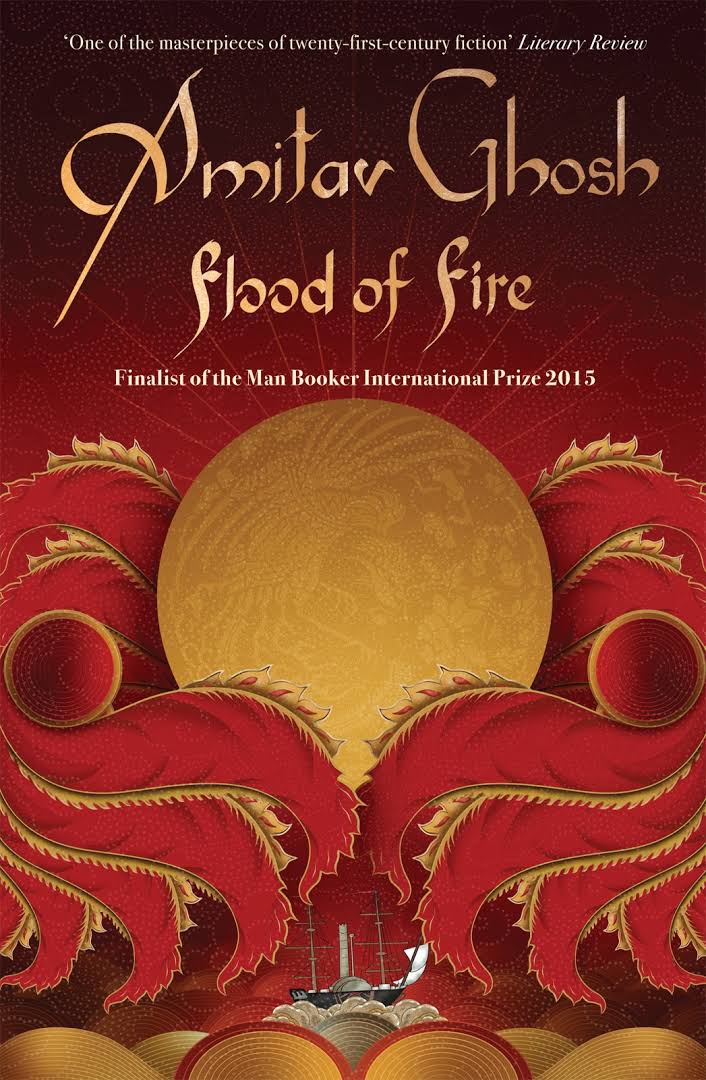
Flood of Fire by Amitav Ghosh

I have read several trilogies but with almost all of their later versions in the series I got the feeling that the narrative had run out of steam, that there was hardly a second or a third installment and one was made only to capitalize on the success of the earlier books. Amitav Ghosh’s Flood of Fire, the third and final book in the Ibis trilogy, which started about seven to eight years back with Sea of Poppies, never made me feel the same way.

The first two books in the series deal with the period leading to the Opium War and the third one – Flood of Fire – with the war. The Chinese authorities alarmed at the damage opium has caused to the youth of the country has decided to stamp out the British merchants dealing in opium from its shores little knowing that about a year or two later the merchants will manage to get the British government to invade China to force opium back on the Middle Kingdom.

And when the invasion comes the Chinese find themselves ill prepared to face the might of British attack. The period leading to the onset of war is revealing in many ways. The man responsible for upsetting the apple cart of opium trade, Commissioner Lin, an upright and incorruptible high official sent in by the Chinese authorities to deal with the menace of opium, is abruptly removed from his position under fabricated charges of foul play and replaced by his deputy, a pliable man, who is also awarded the responsibility to conduct an inquiry into Commissioner Lin’s wrong doing. 

What a humiliation! But what is the actual reason for Commissioner Lin’s ouster? The British opium merchants had petitioned the local Emperor that Mr Lin had been obstructing free trade (by preventing them from carrying on their opium trade). Defense of free trade, free will, God's will etc are the ruses used by the British to justify the campaign of war. This is the larger point behind Ghosh’s trilogy: unsavory means imperialism uses for its sustenance and expansion. 

Ghosh had turned down the Common Wealth Prize because, as he later said in an interview, it’s a commemoration of the Empire. Ghosh is one of those writers whose subjects change but the central muse remains the same. Take any of his works, and you can trace it back to the effects of imperialism, which includes his latest nonfiction offering – The Great Derangement – where he has blamed imperialism (or its less extreme version capitalism) for the environmental challenges we are faced with.

Despite this larger theme in the background, however, Ghosh has dealt with his character and events with an ideological detachment, just narrating the events as a raconteur avoiding getting self-righteous about anything. As a result, the opium merchants come across not as evil souls but men of their times using a business opportunity.

Almost all significant characters have been carried forward from the second installment – River of Smoke – and some are a continuity of the first. Ghosh has brought them and their related sub plots (and there are many of them) to conclusive end in Flood of Fire. In doing so, however, he has sometimes tried too hard, reading a little contrived in the process.

He has put three important characters to death because their prospects beyond the plot were not too bright or clear. He has made two characters - who had existed in the second version but hadn’t met - fall in love and marry because there was no other visible possibility arising out of their meeting. Many characters which had been given a short shrift in the first and second installments have found sizable space in Flood of Fire.

But that hardly takes away from Ghosh’s strength of characterization. In fact, Ghosh has established his characters with his readers so well that it took me only one or two introductory sentences to recall them upon their first appearance in this edition. 

Neel a scion of a feudal family who started off as a debauch in Sea of Poppies and is arrested for being a defaulter goes through a range of experiences in China where he had ended up after fleeing the ship – the Ibis – which was transporting him to Mauritius to be an indentured laborer – completely redeems himself. Zachary a poor but personable American sailor, in the first book, becomes a wealthy businessman in the last. Aaa Fatt an opium addict and a love child of a successful opium merchant gets killed by a mafia don who had started looking for him in River of Smoke – the second book in the trilogy - to avenge the fact that Aaa Fatt had seduced his lover. And like them there are other characters too whose lives are transformed in the course of the trilogy.

Flood of Fire is not bad but the second one of the pack – River of Smoke – is the best of the three books, with its unhurried and intricate narrative without any attempt to be a thriller.   

Friday, August 5, 2011

River of Smoke - A Delightful Read

Some weeks ago, with rave reviews River of Smoke made an arrival similar to its prequel Sea of Poppies a year or two back. The book was much awaited by the ones who had read the first installment as Ghosh had left many an end untied: Neel, Ah Fatt, Deeti, Kalua etc, and the fate of the schooner Ibis. In River of Smoke, Ghosh deals with majority of those characters briefly, with the exception of Neel, giving them temporal conclusion; maybe to revive them again in the last and final part of the trilogy.

River of Smoke moves the location of the Ibis trilogy from India and the Ibis to noisy, chaotic Canton, bringing in a host of new characters and a whole new world.

Bharam Modi the central character is an opium trader who, like many others, brings his opium cargo aboard his ship, Anihita, with an entourage of retinues, from Bombay to Canton, dropping anchor in Hong Kong as the Chinese authorities have banned the import of the murky substance into mainland China, albeit, despite this ban, foreign merchants continue to bring opium into China aided by Chinese mandarins and commoners, enslaving swathes of its population (rich and poor, old and young) to the deadly substance, ruining their lives for good.

Bahram has made his fortune from opium and is content to overlook the immoral aspect of his business, like his co-merchants, most of whom are English, who justify their occupation by employing the principles of free trade.

The story moves along through a mosaic of plots, sub-plots and details creating the world of Canton and its various characters and their involvement in the main plot in varied capacities. It absorbingly details how the trade goes on under the blanket of ban through an efficient network of people and methods making its pursuers wealthier and greedier all the while. Similarly, Ghosh has described life in Canton with such detailing and skill that it feels like a city and world you know.

Another narrative runs parallel to the opium plot: the search of the golden camila, an elusive flower believed to be available in China and to have great aphrodisiac powers. This part of the story again displays Ghosh’s flair for description and skills with minutiae and shows the amount of research that has gone into writing the book. Belonging to this narrative strand is a character called Robin Chinnery, a young aspiring painter.

Robin often writes letters to another character in the book detailing the general goings-on in the town, bringing to the reader the perspective of a detached observer. As the plot tightens towards the later part, Ghosh effectively uses Robin’s letters to take the reader away from the middle of the action and give a panoramic view of matters. The letters are full of details and are very interesting to read. (Robin, by the way, is my favorite character apart from Bahram Modi.)

The book is a parable on free trade. A huge share of the British empire’s revenue came from opium trade, although the substance was banned in England and in other parts of Europe. When the Chinese authorities clamp down on the trade, the English merchants defend their right to trade opium employing the tenets of free trade and assert that, if required, Britain would not hesitate to declare war on China to defend that right.

But for all their free-trade bluster, the merchants would be forced out of Canton by the Chinese authorities, although the success of the Chinese authorities would be short-lived, attracting the wrath of British and French naval forces to force opium back on the country (the British and French retribution, however, has been briefly talked about by a character in the end and will hopefully be covered in the third book).

This is a book you don’t want to miss and even if you haven’t read the first part – Sea of Poppies – you can start with River of Smoke as it is like a standalone book for most part with very occasional references to the earlier book which hardly break the narrative flow.

Wednesday, July 20, 2011

Learning from River of Smoke

While in India, few weeks back, to promote River of Smoke the sequel of Sea of Poppies, Amitav Ghosh said the questions youngsters were asking him at his book promotions suggested that they see him as a role model – and he felt privileged. I am reading his River of Smoke and the book offers many things to learn from to the budding writer. Ghosh has used varied techniques to lend authenticity to characters and locations and the period in which the novel is set. I am half way through the book and these are the things I have noticed.

The story starts from where its prequel Sea of Poppies had ended. Though the book has a mix of old (from its prequel) and new characters, the new introductions have occupied most of the space so far. I am already well acquainted with the new characters, and their actions and dialogs further the familiarity. Through how the characters react to situations, Ghosh brings out various facets of their personalities. Although Bharam Modi, the central character of the book, doesn’t want to reveal his filial relationship with Ah Fatt, Modi’s illegitimate son, to Neel, every now and then he ends up putting his hand around Ah Fatt with filial warmth - displaying that he is naturally a warm person.

Ghosh uses variations in language to convey the social background and circumstances of his characters. That he has used pidgin (a mix of Hindustani, English and Chinese which was used then by foreign traders coming to Canton) as the language in which his characters communicate to inject authenticity into dialogs is well known. But at a more nuanced level, he has also used change of accent to convey the change of circumstances in his characters’ lives. When Paulette hears Robin, now staying with his illegitimate English painter father for some years, for the first time in many years, she notices his accent has become rounded and English.

Similarly Ghosh describes locations with the help of historical, demographic and architectural details. He also uses food habits – and traces the origin of some foods, like Samsa being the ancestor of the Indian Samosha – to lend life and immediacy to the locations. You have to read the description of Fanqui town, a harbor town where foreign traders stay in community ghettos, to see the extent of detailing. And it’s very absorbing.

To give his reader an occasional breather from the narrative, Ghosh brings in historical figures and has his characters meet them through chance encounters. So far I have met two: Rothchild, a 19th century Jew financier in Britain, and Napoleon Bonaparte.

Letters have also been used to further the narrative. The letters are informative and fun to read and apart from presenting the details of locations and circumstances of the characters, they also show the intimacy between the addressee and the letter writer.

The key to detailing of course lies in Ghosh’s meticulous research. Ghosh’s background as an anthropologist and former professor would have certainly helped in his research and understanding of the times and forces – political and commercial – at work.
Related Posts Plugin for WordPress, Blogger...