Monday, September 2, 2019

Musings on Arun Jaitley


Around two decades ago, during the Vajpayee government, a bespectacled man good-looking in a studious way, was a regular on an NDTV debate program, Big Fight, moderated by Rajdeep Sardesai.  (Big Fight still happens on NDTV but has a different moderator.) Those were the days of Congress consensus (some may call it Nehruvian consensus) and naturally, a new non Congress government was attracting hostilities from all quarters (the media, activist lobbies and the opposition)  whenever & wherever it was departing from the traditional ways of handling big and contentious issues (the economy, Pakistan etc).

Big Fight was among the most popular current affairs programs those days. NDTV was the only English channel of note and there weren’t too many current affair programs. In a way, for many like me, Big Fight was the only way to watch televised opinions on important issues facing the nation. Conversely, it was the only noteworthy platform for public figures with an opinion to be heard.
Big Fight used to host debates on multiple subjects with eminent figures from different walks of life participating in them. But the ones on politics mostly used to have only one figure at the center of the debates representing the BJP government – the bespectacled man. And every participant in those debates would point their barrels at him.

In the spirit of the times, everyone had a bone to pick with the government – journalists, activists and of course opposition leaders. But there was something uncommon happening here. The bespectacled man was out arguing everyone in smooth English laced with legal intricacies and in a suave manner. After sometime I came to know it was Arun Jaitley.

It was uncommon those days because erudition, sophistry and elegant arguments were expected only of people defending the left liberal side of the fence. Arun Jaitley changed that perception in me and I guess in many others. How he would defend some of the things that were quite indefensible back then leaving a trail of outsmarted co-debaters gasping for words and ideas – looked like a superhuman act those days. Nowadays the BJP line prevailing over other lines of political thoughts, in TV debates, has become a common sight and to do so, you don’t require Jaitley’s finesse anymore.

But Jaitley’s superhuman acts wouldn’t save his party in 2004 general elections nor in 2009. 10 years would be a long time out of power.  The first five years in the opposition would be rather uneventful for BJP. A Congress-led UPA 1 would gain momentum under a somewhat steady leadership of Sonia Gandhi and Manmohan Singh. There would be occasional hiccups but none big enough to upset the momentum. (The 2008 Mumbai attack didn’t rattle the UPA government much.) In fact, by the time the Congress-led UPA came back to power in 2009 to serve its second term, some of the pet BJP issues like the real center of power being the Congress party president Sonia Gandhi and not the PM, Congress being a family oriented party etc – had lost their traction on a pan India level.  

Then the scams came – one after another – 2G and many others - and the momentum started slipping away. The rising chorus over the scams and the opposition finally getting its act together set in motion a series of things – leadership crisis  caused by internal bickering among Congress leaders, leaders making their ideological leanings and disagreement with the PM public, Gandhi Family loyalists looking for scapegoats to blame everything on to protect the reputation of the Family etc. This led to a rattled Government failing to function properly (which later came to be known as policy paralysis). This is the time Arun Jaitley came into his own.

In this chaos, there were many mainstream political parties and activist groups (including Anna Hazare’s anti-corruption movement) trying to monopolize the anti-Congress / anti-government space.
And if BJP eventually emerged as the only face of public anger against the Government, it was largely due to the brilliance of Arun Jaitely, the Leader of the Opposition in the Rajya Sabha then. His sharp attacks on the Government both in the parliament and media made sure that in public perception the Government always looked like a house caving in. This public perception of a fumbling government only got stronger with time.

In a way, Arun Jaitely was a politician of the television era. He was never a mass leader. His core competency was being a spokesperson and backroom strategist. In pre television days, such a leader would be permanently in the shadow of another mass leader like Vajpayee, Advani or Modi. What helped him step out of the shadow of a big mass leader and be known was TV. His ability to give long interviews explaining BJP’s stand on complex issues, present a sound political perspective on something, deliver sharp soundbites together with his pleasant personality – made him very media friendly – and probably that’s why we know him so well today.

When he passed away last week, I was finding it difficult to imagine an unfolding political situation without a sharp Arun Jaitely observation on it. I am sure many would have felt the same way. As time goes by we would get used to his absence. A lot more is coming to my mind but the blog has to end somewhere.  

Tuesday, July 23, 2019

Musings on World Cup 2019 & How Cricket Has Changed


World Cup 2019 was a cricket tournament I watched earnestly after several years. The intervening years have changed cricket significantly. A generation of cricketers retired. T20 became very big. New rules came in. As much as everything has had their impact on cricket, T20’s effect has been most transformative.

In the early years of 2000, anything from 230 to 250 was considered a good score. Anything above was match winning. I was surprised to see the ease with which teams, in this World Cup, were scoring 300 plus.

Batsmen took more risks, there were more boundaries and over boundaries, fielding seemed to have improved, there were fewer poor deliveries. The margin of error seemed to have shrunk.

The shortest format of the game, where teams get into tight situations more often than its more generous cousins, has also got teams used to handling adversities. In the past, it was rare to see teams batting second win. Now teams seem to negotiate the pressure of chasing better and often come up triumphs. How England chased in the final, moving in and out of the game almost in every alternate over, is a good example of that.

I also saw lot of unconventional shots being played with ease and success. Again, in the final, it was heart-stopping and delightful, at the same time, to see Jose Butler spooning balls, with his bat, over the wicket for boundaries. Most of the shots were played during tight situations when his dismissal would have dealt a mortal blow to England’s Word Cup chances, yet he took the risks, an indication that team leaderships are more welcoming of risks taken even if they lead to setbacks. 

And undoubtedly these are the bequests of T20, allegedly the most vulgar of all forms of the game.
Only one bequest of T20 is not so good. And that is the ICC rule that in case of a tie in a Super Over the team hitting the most number of boundaries would win. This rule has been adopted from T20. After the match, the Kiwi captain said they couldn’t complain because they were signatories to this rule. Great professionalism! They wouldn’t have thought it would come to haunt them in the final match and be the singular reason for their defeat or England’s victory without outscoring them. The more I think of it, in fact, the more life seems unfair.

But the bigger question is not the vagaries of luck, but lack of judgement in adopting a rule from T20 which is not suited to its longer counterpart, ODIs. The 50 over format was derived from Test – and it has the languid characteristics of Test. One offers enough space to both the bowler and batsman. The bowler gets as many as 10 overs to bowl. And if you are a batsman, and you are not comfortable hitting the bowler, you can just play him off and have your colleagues at the other end handle him. T20 does not allow this space. You cannot plan your innings in a similar way.

The bowler can only bowl a few overs in which either he takes wickets or he gets clobbered. T20, which is a derivative of ODI, is not about intrigues but solely thrills and chills. Boundaries are a defining characteristic of T20, but there is a little more to ODIs. Therefore the T20 rule, which takes the number of boundaries as the yardstick to decide the winner in case of a Super Over ending in a tie, is reflective of the personality of T20, a derivative of ODIs, but not ODIs, a derivative of Test. The personality of a format is partly determined by its progenitor and partly by the intent behind creating the format. One days were invented as a shorter version of Test; T20s were invented as shorter versions of one days.

Thursday, May 4, 2017

A Flight of Pigeons by Ruskin Bond

If a movie is made based on a book you have read, watching the movie is a must. But if you have seen a movie based on a novel you haven’t read, it’s unlikely that you would read the novel. We somehow tend to believe it’s always a novel to a movie and the reverse journey doesn’t excite us a much. But with The Flight of Pigeons by Ruskin Bond I did make that reverse journey.

I had watched Junoon (based on the novel The Flight of Pigeons) many years ago and liked it, the story of a passionate one-sided love of a Pathan for an English girl in the wake of the Sepoy Mutiny of 1857. A few years ago I chanced upon the book the movie was based on. A few months ago, after wanting to read it for many years since I saw it the first time, I finally read it.

 In a foreword Ruskin Bond informs that as a kid he had heard the story from his father, who, in turn, had heard it from Bond’s grandfather, a soldier those days, several times. The incident which took place in a small town in UP (Sharanpur) during the Mutiny had captivated a young Bond.

Many years later, when Bond decided to write a novella based on the incident,  he visited Sharanpur and found many of its parts, especially those the British families occupied in the days of the Mutiny, unchanged from how his father had described them.  

The action starts with a church where a mass is underway being attacked by rebels inspired by the hate wave that’s blowing across swathes of the country against the British. Among others, the narrator’s (a British teenage girl) father is killed. 

Following the death the family takes shelter in a Hindu merchant’s house who has braved the consequences of sympathizing with a British family amidst the anti-British frenzy which has gripped the town. 

In the meantime, a Pathan, a married man with a reputation for his dare devilry and cruelty, who is wreaking havoc in and outside the town by killing and looting the British and wealthy Hindus and setting their establishments ablaze, has taken a shine to the British girl and coaxes the Lala to let the family go with him and stay in his haveli.

After bringing them to haveli the Pathan does what was not expected of him. Instead of forcibly marrying the British girl or dishonoring her, he asks her mother for her daughter’s hand and the mother says the Pathan could marry her daughter if the rebel side won the war. Finally, the British win the war.

After some time the British reenter the town of Sharanpur to the relief of its British inhabitants and those who had persecuted the British families following the outbreak of the Mutiny and the reverses the British had suffered, flee the town to escape British retribution. 

However, after knowing that the lover Pathan has fled the town and gone beyond any possibility of return or been seen again, the British girl, in a silent acknowledgement of her softness for the handsome and chivalrous man, wishes him a safe passage.

By reading the outline of Flight you would expect it to be a romantic thriller, but it is not. After the initial burst of action it settles into a slow pace and shows reveals different layers of the story. 

The reaction of the people to what the Pathan wants to do, the transformation of the Pathan from a reckless troublemaker to a lovesick man patiently awaiting the matrimonial permission of his muse’s mother, the grit of the girl’s mother, who, despite the fact that she and her family are at the mercy of the testy Pathan, manages to keep her wit and composure in place.

And then you have the magic touch of Ruskin Bond to savour.  

Monday, March 6, 2017

One Year with My Maruti 800

This month my car – a Maruti 800 – completes one year with me and nine years since it rolled out of a showroom. Yes, when I purchased it last March, it was eight years old. And as is expected of a car that old, it did give me some troubles and caused me minor expenses for the first eight months or so. But after the first burst of repairs, it seems to have stabilized and functions smoothly without being an irritant.

This one year with the car has been a series of discoveries.

One of the reasons for buying the car was learning how to drive, which I had tried many, many years ago with a cousin’s second hand Premier Padmini and had not been able to get the clutch and brake coordination correct resulting in the car starting and then stopping without moving an inch.
I was booed at.  Frustrated, I left trying. After that unsuccessful attempt, I never tried my hand at driving again until I joined a training school last year.

The first thing I learnt was - driving is not easy. It is an applied art - where how good you are at it is determined not by how well you know the theories but how deftly you apply them when behind the wheels. You are told a few things at the school and many more you discover on your own.

It requires a mix of many skills. You have to take quick decisions, you have to have quick impulses to react to situations, you need what I would call space-ial intelligence, and as you are doing all this, you have to remain calm and relaxed. 

That I am able to successfully drive came to my mother as a surprise. A year ago, when I started learning, I would be surprised to know that a year later I would be able to drive. My personality traits run contrary to the prerequisites of driving.

I am slow to react to situations. I am a slow thinker. I am confusion-prone. And generally I place a chair or  table right the second or third time.

It took me two months of training (10 hours) and six months of practice to overcome my natural deficiencies. Probably it would be a little longer had it not been for the fact that I had a Maruti 800 to learn with.

These six to eight months were not without pain. Once, while trying to complete a 60 degree turn, I hit the bumper of an SUV and had to pay heavily to get it repaired.  The driver of the SUV informed me, while we were returning from the service center, that there was a new driver who had hit the car bumper against a pole while backing it. “Sale ko chalana nehi ata.” I would be thankful to him if he had not told me.

The other mishaps were minor but enough to dent my confidence for a while. Along the way, I also learnt a few life lessons.

One of my friends, who learnt driving about four years ago, told me the guy who shouts first in an accident and shouts the other guy out generally gets mob support and prevails: “Yaar, a second later no one knows whose the fault was.”

Seeing me appreciating his point, he shared a deeper human insight: Following a crisis, we pretend to look for the actual culprit, but actually we look for a fall guy - enough to quell our anger!

I learnt another thing: driving doesn’t get the credit it deserves because it’s a poor man’s job.

Monday, February 27, 2017

Silence - a Movie That Will Stand the Test of Time

When a new arrival – a book or a movie - is based on a piece of history you are familiar with, it does not leave you with too many options – you have to devour it. So when in promo pics of Silence, the latest movie by Martin Scorsese, I saw two guys with scrubby beard looking like coming from another time in an exotic mountainous locale, it piqued my curiosity. (I was not familiar with Scorsese‘s reputation and repertoire.) Upon digging deeper, I came to know Silence deals with a piece of Japan’s past I had read about many years ago.

The time is 16th century and Japan is going through a period of extreme religious persecution aimed at those who have embraced Christianity and Jesuits operating in the country. Amidst this, two Portuguese jesuits visit Japan to find out about their mentor jesuit – father Ferrero - who is said to have abandoned his faith in Christianity publicly, and also to help Christians facing persecution in the country.

This is the period which has a parallel with post Nagasaki Hiroshima Japan: when the nuclear attack forced the country into a shell – to rebuild a nation maimed by a war and nuke. Many say these two incidents and their aftermath left Japan with a permanent paranoia for the foreigner (much like what the Opium War did for China) which still informs its public policies.  However, people familiar with the bit of Japan’s history Silence deals with will trace the source of that paranoia a little further back in time.

An edge-of-the seat suspense takes you through the first half an hour or so of the film and then it slowly dissipates and the film gradually settles into an easier pace but a certain tension continues to characterize the narrative throughout, thanks to the subject, but also how the director has brought that element to bear upon the narrative.

Given the nature of the subject Scorsese has chosen for Silence, a plaintiveness running across the film is understandable. But the scenes depicting the dehumanizing treatment meted out by Japanese officers to those who have moved to Christianity, mostly poor villagers, leave you with a sour mood. And this I feel helps the evangelist  side get sympathy with the viewer and win the argument obscuring the viewer to the fact that  the colonial powers often hid sinister intent behind the guise of faith (many advocates of the Opium War on China had used faith as their justification), a point that Scorsese’s movie overlooks. 

In fact, many would say Silence is a passionate argument for Christianity - one of the travelling Portuguese padres dies but the other lives and goes through a forced public denial of his faith in Catholicism following which he becomes a Buddhist and never acknowledges his faith in Christianity in his lifetime only to be shown with a cross in his rolled palm when he is being cremated as per Japanese customs - in an apparent show of trump of his Christian beliefs. 

Be that as it may, I wholeheartedly rooted for the characters undergoing persecution and the torture scenes left me downcast for a long time.

Silence is easily a classic, something which will stand the test of time and be remembered respectfully many years later for several things – great cinematography (some of the scenes are simply breathtaking), authentic recreation of a period in history (the monasteries, the wooden structures, everything looks so much like they have leapt out of the period) and above everything else a film which powerfully tells a story showing the two sides of religion – devotion and intolerance.

It’s a must watch.

Tuesday, January 17, 2017

Where Are We with Demonitization

It’s been sometime since I wrote the earlier blog on demonetization – and the situation has changed since then. We have got used to the new normal – that ATMs will not be the same again, that some visits to ATMs will be disappointing, some fruitful, that 2000 rupee notes will be in greater use than 1000 rupee denomination ever was and therefore getting it changed will always be a concern, that although a complete cashlessness may still be some years away, more and more number of small shops, the most formidable bastions of cashbased transactions, will offer digital options for payment. In sum, liquid cash will become less and less part of our day to day lives.

Well, all this is good news, but is it the whole picture or just an urban snapshot? From the reports that are emerging, rural India is still smarting under the effects of demo. A few days ago a news portal solely reporting on the effects of demonetization on rural India reported that in Maharashtra prices of some vegetables have dropped substantially due to over supply resulting from the inability of middle men to buy them due to lack of cash availability  (these transactions are almost always cashbased). Some rural regions are not receiving enough cash supply in their banks – and it’s a bigger concern in rural areas than in urban ones.  

And even in urban areas, even by the standard of the new normal, order has not completely returned. Most ATMs are still out of cash. Most of those that are working are mostly dispensing Rs 2000 notes.  Many have concluded that visits to banks to draw cash via cheques is a better option than depending on ATMs; but then if that is so, then does it not defeat the whole purpose of demonetization?

By now it is undeniable that the implementation has been a disaster. How the government and various financial institutions have reacted to situations suggests they were not foreseen and planned for earlier. Surprisingly though, as it appears, demo hasn’t hurt the government politically, although many would suspend their judgement about it until UP delivers its verdict.

Apart from Modi’s thunderous speeches, what has helped the government is that the opposition continues to be hopeless. To start with, there is hardly any opposition unity. Some parties are ambiguous about their stand on demo, some are half-heartedly supporting it by maintaining silence, some are mindlessly hurling accusations none of which is sticking. 

Amidst this chaos, though, one thing is becoming clear: emergence of a new order of payment methods, networks etc. The problem is how fast people can get used to the emerging order. The lightning speed with which demo was brought by the government will keep people on their toes, causing them to rush to the new transaction practices, in terms of learning them and making them an integral part of their day-to-day financial transactions.

Good or bad, this attitude towards government-brought changes is another bequest of demonetization. In the past, whenever it came to matters relating the government, people felt things would largely remain the same and they would be able to bypass the minor changes and survive the effects. Such comforting assurances have become a thing of the past. 

In the meantime, stories will keep emerging, some funny, some tragic. Let us look at this one from Karnataka. To raise funds, to help a depleted exchequer, the government is invoking an old law where pubs will have to achieve a minimum target of liquor sale set by the government, falling short of the target will attract penalties.

Monday, December 5, 2016

The I and We of Demonitization

It’s been sometime I have been at the receiving end of the effects of demonetization. I still am confused whether what the government is telling is right, that it’s today’s pain and tomorrow’s gain. Or what the opposition parties are claiming is true, that it’s not going to serve the intended purpose of eliminating black money, that it’s legalized loot, that nothing will prevent counterfeiters from counterfeiting the newly introduced notes and so on. 

Whichever side of the argument you are on, a few things are very clear. It’s almost a month since  demonetization and the situation on ground is still not back to normal. Most ATMs are not functioning, barring a few located in prominent places per area. The load on these few functioning ATMs is so high, as a result, that they are running out of cash within a few hours of refill. I stood in long queues of several such ATMs and the cash ran out when my turn was two to three people away. The luckiest ones walked away with 100 rupee notes, the luckier with 2000, some (including me) had to return emptyhanded. Even if you are lucky to get some cash, there is restriction to how much you can draw. Until some time ago ATMs cards from banks other than the host bank were not working. Now they are.

Like many of you, I am tracking this development closely and have read several articles and heard some interviews. Posthumously, they say a range of things which could have prevented or at least brought down the scale of the crisis. Instead of banning both 500 and 1000 rupee notes, they say, the government could have banned one – preferably  1000 – and left the other, which would have given them time to replenish the banned notes and also the option of targeting the 500 rupee denomination later. If they had taken some time to make all the notes the same size, which is how it is in many countries, the ATM machines would not require recalibration, they say.

These ‘should have beens’ may not bother us much now that it’s too late, but at a national and personal level there are a few possible outcomes of them. The happy political consensus over GST seems to have dissipated and reorganized itself as a pan India opposition against the government over demonetization. No one seems to mind the purported goals – end of black money, cashless economy etc - of demonetization; given their lofty nature, they are slightly unchallengeable. The opposition parties seem to smell a political opportunity in how demonetization has been carried out. And that seems to be the bone of contention for the amm janta too…who may think, if the mainstream media reports are to go by, that little bit of pain is worth the long term gains. But as each day goes by without the situation coming under control, the concern that’s becoming bigger and bigger is: how long the patience will hold out?

The answer to that lies in several things. How long will the government take to pull the situation under control? How soon, in what forms and how tangibly will people see the benefits of the pain they are undergoing? How long the government will be able to prevent the growing voice of a uniting opposition into becoming a nationwide roar (something like the G scams)?

A lot of this will require perception handling. Also, as the government works towards getting things in order, care has to be taken to make sure that nothing undermines the ground which is being covered on the way to normalcy. The system has countless holes through which illegal money can travel back and forth having a termite-like effect. And there is enough evidence that this is happening. New notes worth over Rs 4 crore have been seized in income tax raids in Bengaluru. Similar incidents have been reported from other parts of the country. And there are inherent challenges. One of them is the unorganized economy in India is intricately entwined with the mainstream economy and the former is mostly (unless it is illegal) cash based.

On ground a few things need to be made smooth so that after I get a 2000 rupee note it’s easy for me to find change or there are enough 100 notes in ATMs. The number of functioning ATMs should start growing so that I don’t have to stand in queues for too long. If the problem is to linger for a few more months, then special arrangements should be made on payment days, either by pumping in more currencies or devising ways to identify and move as many as possible to crediting their stuff salary into their accounts.  None is easy. And what makes it difficult is this hydraheaded monster has to be tamed FAST.

Wednesday, October 26, 2016

The Great Derangement: Climate Change and the Unthinkable by Amitav Ghosh

There are very few books that fill you with a sense of urgency to write something on them before it’s too late. Amitav Ghosh’s The Great Derangement: Climate Change and the Unthinkable, which marks the author’s return to nonfiction after a long while, is one such book. The Great Derangement…delves into history (literary and political), analyses contemporary practices, our choices and preferences...and tells us how they are collectively responsible for forcing the nature to unleash destructive forces - like earth swallowing floods, monstrous earth quakes, gales with never-heard-of speed and ferocity – and have brought us to the edge from where a return journey is not possible unless we immediately stop the ‘march of modernity’.  

The book blames several things for the climate challenges we are faced with – one is history, another is indifference of serious fiction towards climactic matters, another is the apathy of governments to climactic concerns, still another is our lack of awareness about the havoc climate change can wreak in our lives although there is no dearth of evidence around us.

Ghosh is most morbid about the middle class when it comes to suffering from impact of climate change. He says the rich will fly away in airplanes, the poor will go away to their villages, but where will the middle class go given the fact that they have built their lives in cities? In other words, Ghosh says cities are most vulnerable to the effects of climate change.

And particularly those that are close to sea or other forms of water bodies, like Mumbai, Hong Kong, Singapore, Calcutta. Most of these cities were built in colonial period to act as good trade and commerce centers because of their proximity to water. And somehow this preference for proximity with water has crept into the elites of these cities, who tend to build their settlements close to water. The richer the closer.

This love of the rich for staying close to water makes the sea-facing locations most coveted real estate pieces. And, Ghosh observes, this desirability of these locations as real estate properties, anywhere around the world, makes it difficult for governments (or municipal bodies) to create awareness about the perils of staying close to water bodies, thanks to the political clout the real estate practitioners enjoy everywhere.  

For Ghosh the peril of this proximity was best exemplified when he travelled to Andaman and Nicobar islands to report on the impact of tsunami.  He visited an army settlement located close to the sea. He noticed two things: a) the higher the rank of the occupant, the closer his dwelling was to the sea leading to the highest rank holder staying closest to the sea (and vice versa); b) those closest to the sea were affected the most by tsunami.

Ghosh observes that in the pre-colonial period people lived away from water, but with the city-building projects the colonial masters took up, the preference slowly reversed.

One of the most original points Ghosh makes in Derangement is the indifference of literary fiction to the concerns of climate change. According to Ghosh, some of the practitioners of serious fiction in the 19th century consciously moved away from using fantastical elements – like flying carpets or a rising sea gulping a landscape – as a means to tell stories, in order to focus on more prosaic day-to-day affairs of life. This prosaic-ity fulfilled the requirements of serious fiction. So describing minor details of landscape and how people lived their lives became fashionable. Amitav Ghosh says this shift from writing about fantastical occurrences to more mundane motions of life had to do with the emphasis of the Industrial Revolution on betterment of human lives.

This shift made the fury of nature, like floods, cyclones etc., an untouchable terrain for serous fiction – because, as Ghosh observes, the gigantic scale of these furies of nature lends them a fantasy-like incredulity not to be dealt with in the type of fiction which swears by credulity.  

Writing on furies of nature fell to less-respected a form of fiction, genre fiction. And, Ghosh rues, it continues to this day. That is why thrillers and science fiction have addressed climactic concerns; but sadly, the author says, because genre fictions hardly receive any serious literary award, the issues they address don’t receive the attention they deserve.

One of the things responsible for pushing us to the brink is replacement of coal with petrol as a fuel. Petrol is a more versatile fuel than coal but that is not the only thing which explains why petrol usurped coal’s position as a primary fuel: the reason is petrol is a politically safer fuel than coal – and what makes coal a politically volatile fuel is the highly visible mining process involved in it unlike the refinement process of petrol which is very opaque.

Remember the blackened face of the 20th century coal miner melancholically looking at you from a black and white photo? This visibility of the plight of coal miners is responsible for the revolutions that coal mining has led to unlike the plight of petroleum refinery workers which suffers in obscurity. And the political elite of the Anglosphere the Churchills and Roosevelts of this world knew about this disadvantage of coal mining, Europe having experienced many of the coal-triggered revolutions, and ensured that coal was replaced by petroleum as a primary fuel.

But as always Ghosh’s favorite whipping horse is once again colonialism. He says Britain made sure that the benefits of the industrial revolution were denied to its colonies – and that’s the kind of development that took place in the Western world didn’t take start in Asia until the 1950s when the colonies started getting independence. But, according to the author, the earth can’t withstand the rigor of another round of Western-style development.

That’s why, in climate negotiations taking place among nations, the Western nations insist the poorer nations to take a different route to development.

Ghosh says governments across the world, particularly the democratic ones, come to power on the promise of fulfilling people’s aspirations – and therefore are ill-placed to ask their citizenry to view their actions in the light of their moral responsibility towards saving the earth from going over the edge. It’s only religious groups that can do that. And Ghosh praises the book Laudato Si written by pope Francis in this regard and does a comparative study between the papal book on climate and another important treatise concerning the same subject, The Paris Agreement - and concludes that Laudato Si is much more lucid and readable of the two.

You can take The Great Derangement in many ways – as a book which preaches, prophesises, disparages - by asking us to happily forgo the type of modern development the Western nations have taken for granted. And I am afraid seeing the book in any of these ways will obscure you to its merit as a well-researched book which forcefully holds a brief for climate and makes some unique points along the way. But it does so not without occasionally sliding into ideological slots avoiding which would have ensured a wider acceptability of its views which are certainly worthy of attention.

Wednesday, September 28, 2016

Making a Break with the Past with Enid Blyton

Let me start with an admission: I have committed a literary sin. While touring Chikmagalur I walked into an old ramshackle book store in the corner of a street and found myself looking at dusty, cheap copies of biographies, science books, old classics etc. Further into the shop, and I saw a bunch of slim colourful books with glossy cover bunched up in a corner. They were Enid Blyton books.

I started reading novels very late. I read my first novel – Five Little Pigs or something, an Agatha Christie one – when I was in class eleven. Not sure what reader category that puts me in. And after that novel I took baby steps in to the world of fiction - picking up new books liking some of them not liking the others while not managing to get very far with some of them. I tried out several commercial writers from America and England those days – John Grisham, Arthur Hailey, Jeffrey Archer, Sydney Sheldon, Jackie Collins. (I continued with John Grisham until very late – and even now miss some of his books.)

Back then I wasn’t bothered about writers’ reputation or whether someone was a commercial or literary writer. I developed these pretensions in later years. Those days a good synopsis was enough.

But that day, at that bookstore, when I held up the Enid Blyton bunch and drew out one from the middle of it, I wondered despite my lack of class consciousness so many years ago why I didn’t try out Enid Blyton, a writer of racy children’s fiction. The answer is I was age conscious. I had taken to books to grow up – and a children’s author just wouldn’t do! In later years, when I developed a fetish for serious writers, Blyton was naturally out of the question. But my indifference to Blyton didn’t prevent my brushes with her.

In my earlier reading days, when I used to buy or rent my books from street side book stalls selling pirated copies, the sight of Enid Blyton books stacked up in a corner was unmissable. In later years, when I started reading articles and reviews in literary magazines (and still do), a mention or two of Enid Blyton came in almost in every piece on Indian writers writing in English - where Blyton was mostly recalled with nostalgia – as a forgettable writer who had got the Indian English writers interested in reading but was forgotten soon after. A few years back BBC called her the dumbest writer of the 20th century (or something similar).

That day at that ramshackle bookstore in Chikmagalur I decided to make a break with the past. Three Cheers, Secret Seven was…yes…no great literary piece making timeless observations on society…or human nature…but a simple mystery story involving a bunch of children (the Secret Seven) set in provincial England. Susy a socially awkward girl who is not a part of the Secret Seven group but is a constant presence in it, thanks to the fact that Susy is Jack’s brother, a Secret Sevener, gets a toy flying airplane as a gift.

It’s a beautiful gift which some including Jack fail to resist. And Susy lends it to them to play with. They fly the miniature aircraft and it goes and gets stuck on a tree located inside the garden of an abandoned mansion. The Secret Seven approach the caretaker. He refuses to return it. At night, stealthily, they go in and up the tree and retrieve the toy. However, while atop the tree, Peter, the group leader, sees a strain of light peeking through the slit formed by two curtains drawn together  – suggesting that someone could be inside. But who? And why? A lot of investigation later they discover it’s the mansion caretaker with his wife.

The plot is simple and straight forward with a moral and social justice angle to it. The caretaker’s wife was suffering from poor heath due to the cold and damp hovel they stayed in and the caretaker had been asked by the doctor to move her to a warmer place – hence their presence in the uninhibited mansion.  But for all the moralizing, there is that old school patronization for characters that don’t fit in to the conventional mold. The character Susy comes in for occasional derision because of her awkward personality. A modern author would have dealt with Susy more gracefully.

Complexities apart, I enjoyed the book and wish to read more Blyton books – and mostly over weekends.

Tuesday, September 20, 2016

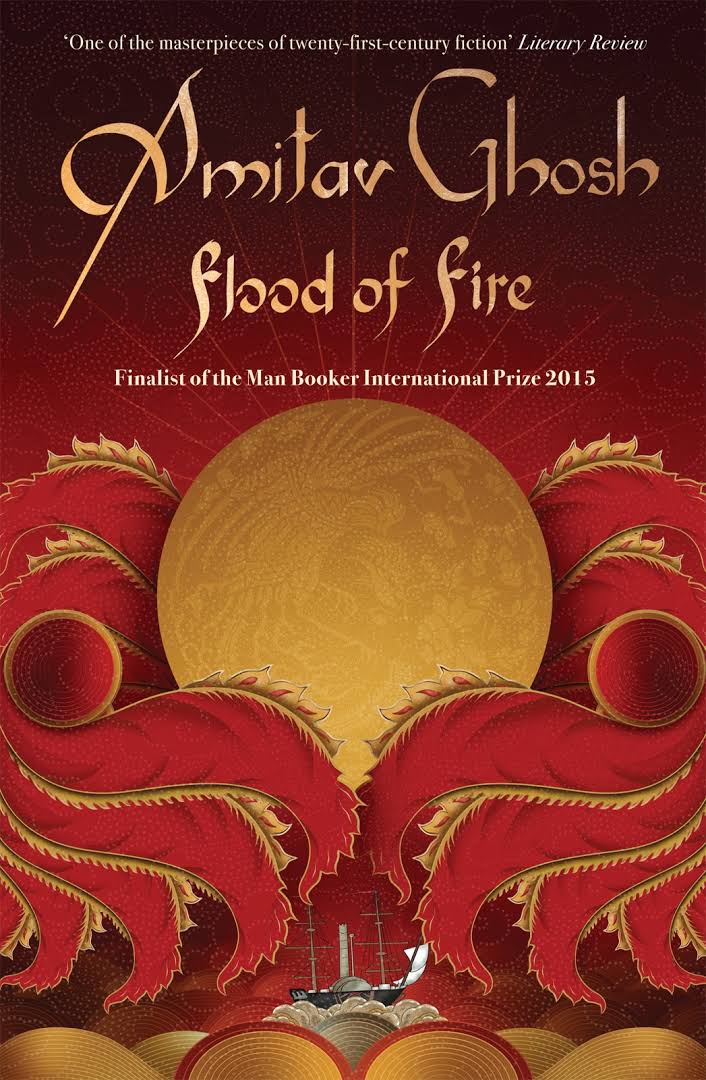
Flood of Fire by Amitav Ghosh

I have read several trilogies but with almost all of their later versions in the series I got the feeling that the narrative had run out of steam, that there was hardly a second or a third installment and one was made only to capitalize on the success of the earlier books. Amitav Ghosh’s Flood of Fire, the third and final book in the Ibis trilogy, which started about seven to eight years back with Sea of Poppies, never made me feel the same way.

The first two books in the series deal with the period leading to the Opium War and the third one – Flood of Fire – with the war. The Chinese authorities alarmed at the damage opium has caused to the youth of the country has decided to stamp out the British merchants dealing in opium from its shores little knowing that about a year or two later the merchants will manage to get the British government to invade China to force opium back on the Middle Kingdom.

And when the invasion comes the Chinese find themselves ill prepared to face the might of British attack. The period leading to the onset of war is revealing in many ways. The man responsible for upsetting the apple cart of opium trade, Commissioner Lin, an upright and incorruptible high official sent in by the Chinese authorities to deal with the menace of opium, is abruptly removed from his position under fabricated charges of foul play and replaced by his deputy, a pliable man, who is also awarded the responsibility to conduct an inquiry into Commissioner Lin’s wrong doing. 

What a humiliation! But what is the actual reason for Commissioner Lin’s ouster? The British opium merchants had petitioned the local Emperor that Mr Lin had been obstructing free trade (by preventing them from carrying on their opium trade). Defense of free trade, free will, God's will etc are the ruses used by the British to justify the campaign of war. This is the larger point behind Ghosh’s trilogy: unsavory means imperialism uses for its sustenance and expansion. 

Ghosh had turned down the Common Wealth Prize because, as he later said in an interview, it’s a commemoration of the Empire. Ghosh is one of those writers whose subjects change but the central muse remains the same. Take any of his works, and you can trace it back to the effects of imperialism, which includes his latest nonfiction offering – The Great Derangement – where he has blamed imperialism (or its less extreme version capitalism) for the environmental challenges we are faced with.

Despite this larger theme in the background, however, Ghosh has dealt with his character and events with an ideological detachment, just narrating the events as a raconteur avoiding getting self-righteous about anything. As a result, the opium merchants come across not as evil souls but men of their times using a business opportunity.

Almost all significant characters have been carried forward from the second installment – River of Smoke – and some are a continuity of the first. Ghosh has brought them and their related sub plots (and there are many of them) to conclusive end in Flood of Fire. In doing so, however, he has sometimes tried too hard, reading a little contrived in the process.

He has put three important characters to death because their prospects beyond the plot were not too bright or clear. He has made two characters - who had existed in the second version but hadn’t met - fall in love and marry because there was no other visible possibility arising out of their meeting. Many characters which had been given a short shrift in the first and second installments have found sizable space in Flood of Fire.

But that hardly takes away from Ghosh’s strength of characterization. In fact, Ghosh has established his characters with his readers so well that it took me only one or two introductory sentences to recall them upon their first appearance in this edition. 

Neel a scion of a feudal family who started off as a debauch in Sea of Poppies and is arrested for being a defaulter goes through a range of experiences in China where he had ended up after fleeing the ship – the Ibis – which was transporting him to Mauritius to be an indentured laborer – completely redeems himself. Zachary a poor but personable American sailor, in the first book, becomes a wealthy businessman in the last. Aaa Fatt an opium addict and a love child of a successful opium merchant gets killed by a mafia don who had started looking for him in River of Smoke – the second book in the trilogy - to avenge the fact that Aaa Fatt had seduced his lover. And like them there are other characters too whose lives are transformed in the course of the trilogy.

Flood of Fire is not bad but the second one of the pack – River of Smoke – is the best of the three books, with its unhurried and intricate narrative without any attempt to be a thriller.   

Friday, August 26, 2016

Greatest Bengali Stories Ever Told - a Collection of Bengali Short Stories

A collection of short stories written by writers writing in the same language and coming from the same place can often cover the past and present of a place more widely than it is possible for a novel which, even those moving back and forth in time to cover a long period, mostly takes a linier trajectory. 

The Greatest Bengali Stories Ever Told translated by Arunava Sinha do something similar: the collection brings together the work of the most famous and not so famous Bengali writers coming from different periods and places of Bengal and covering a huge landscape from Bengal’s past and present.

Alas, it is hard to understand whether it is by design or accident. Sinha informs us, in the introduction, that his choice of stories isn’t based on any scholarly or thematic consideration; instead on what he considers best stories or stories he has been able to place himself.  On a more informative note, he informs us that Bengali short stories can’t be traced to any particular period or group of practitioners of the form; they were always being written; they were always there, evolving with time.

The first story in the collection is Rabindra Nath Tagore’s famous Kabuliwallah. Having seen its movie adaptations, which were lengthened by songs, I felt the story ended too soon, although it  read surprisingly fresh.  Mahesh, by Sarat Chandra Chattopadhyay, tells the story of a Muslim man who owns a cow called Mahesh and takes care of the animal with fatherly affection and care. One day, due to Mahesh, misfortune visits him and enraged he hits Mahesh on its head killing the animal. The village turns against him accusing him of cow slaughter. It was written around a century back.

Einstein and Indubala deals with our preference for entertainment over scholarship. Einstein visits a small town to deliver a lecture. On the day the lecture is scheduled, there is another event in the town which everyone is awaiting: a live performance by Indubala, a cine sensation.  When Einstein arrives at the lecture venue he finds all the seats empty. 

The guard informs him that everyone would have gone to watch Indubala perform.  Finally the scientist goes to the place and finds the organizers of his lecture sitting there. Bibhutibhushan Bandyopadhyay had written it based on a report he had read in a newspaper.

I found Sunil Gangopadhay’s Post Mortem too incoherent. It reminded me of what the writer had once told about writing short stories. In his initial days as a writer he was reluctant to try out short stories, until a friend told him one day that writing short stories was easy: write what you do in a day, from the time you get up to the time you go to bed, and stop somewhere, and you have a short story.

Swapan is Dead, Long Live Swapan by Udayan Ghosh deals with Naxalism, the only story in the collection to deal with the socio-political issue which had rocked Bengal in the 70s. I also liked Mahaswtha Devi’s Urvashi and Johnny which is about people who call streets their home. There are a few more in the collection.

The literary merit of the stories notwithstanding, the book’s title -The Greatest Bengali Stories Ever Told - could be a little more understated as also the title of its introduction where Sinha justifies putting together the collection – My Love Affair with Bengali Stories.

Tuesday, June 21, 2016

Gachar Gochar - the Problems Wealth Brings

Usually we blame our problems on lack of wealth. Gachar Gochar, written by Vivek Shanbhag in Kannada and translated into English by Srinath Perur argues the opposite: wealth brings problems it its wake. Gachar Gohchar manages to make its point very succinctly, in only 115 pages through the story of a Kannada family which goes from lower middle class existence to prosperity following the success of a spice business the family starts with the corpus received from the forced voluntary retirement of its sole earning member.

The narrator, a member of the family, takes you through how the family gradually loses its coherence as wealth comes in. The spontaneous family gatherings stop, the dependence on each other goes, minor differences which had found scant attention earlier start developing into prominent fissures, some of its members scuttle their responsibilities and settle for easier choices money and power can provide; gradually middle class values, which had held the family together earlier,  erode. The narrator makes timely interventions stepping back from the story and giving observations on the happenings to press home the point: that it’s the new entrant money which is behind the changing complexion of the family.

Despite the seriousness of the topic, Shanbhag manages to make you laugh for most part of the book with situations that are common to all middle class joint families. But what impresses you the most is the rootedness of Gachar Gochar into the world that it belongs to. 

Vivek has captured the idiosyncrasies of a middle class family excellently through their day-to-day habits and practices, like a discussion started at the dinner table far outlasting the food and the family members hearing engrossed even as the remnants of the food is caking up on their fingers or a member absent-mindedly picking up grains of rice from his plate and putting them in his mouth one by one as he his listening to what’s being told.

The story is inconclusive, in that the family doesn’t lose the acquired wealth and return to poverty; but towards the end, a sudden outburst by the narrator’s wife, Anita, the only daughter of a professor, and ill at ease in the atmosphere of new money that is her husband’s family, against the patriarch of the family (Chikkappa) who takes care of the spice business and whose authority in the family never suffers a dissent - throws the faultlines into sharp focus: that new money also creates a certain power structure of which others live and to ensure continuity of their vested interests they avoid challenging it, however unscrupulous be its way of ensuring that continuity.  

Following the outburst by Anitha the suffocating silence maintained by the family members on Chikkappa is broken – and in a throwback to the old times, the family gets together again around Chikkappa to hear his stories.


The end is like outpouring of rain following a parched day. Gachar Gochar is another example of the gold mine that is our vernacular literature. 

Tuesday, May 24, 2016

The New Type of Leader in the World of Politics

There is a new type of leader finding acceptability in the world of politics. Political rhetoric has always been one of appropriateness where conventional or traditionally acceptable views are considered safe. Issues change but how they are talked about by the conventional political leader remains the same. 

The new type of leader is breaking this mould. They don’t care about traditional views. They are blunt. They say the unsayable. They often put their foot wrong with their comments and earn all round derision, but get up, shake off the dust and start walking again. They apparently don’t care about their image but end up creating one for themselves. And surprisingly, this new type of leader is finding political success.

With every passing day, Donald Trump is inching towards becoming the Republican candidate for presidency. And as the silver-haired American millionaire spouts one politically blasphemous statement after another, Indians are saying: “Doesn’t he remind us of someone closer home?” 

Conservative French politician, who is now an MP, Marine Le Pen, who is often called xenophobic, is another example of modern day politicians who are not afraid of expressing unconventional (or even unpalatable) views.

A general brashness, though, is not the only attribute characterizing all of them. Some of them, in fact, may appear like a chip off the old block, in terms of general behavior, but occasionally, when an issue warrants, they show scant regard for tradition. Roughly six months ago, David Cameron said ‘it is because of these important religious roots and Christian values that Britain has been such a successful home to people of all faiths and none.’ And despite the instant disapproval of British intelligentsia, he never apologized or tried to explain himself.

However, if you see beyond the bravado and examine the comments of the brave hearts in the light of current global realities, the brave hearts will appear less foolhardy and more pragmatic. You will realize they are making unconventional statements because they know they reflect the opinion of masses, that even if they are lambasted by the cognoscenti, they will gain politically. And it is working. People feel these leaders are less pretentious, that they say what is obvious but unsaid. When they speak people feel heard. Elections after elections have shown that these sentiments convert into votes. 

This trend is a fallout of mainly two geopolitical realities. One is growing Islamic extremism and global financial crisis – which none of the conventional political leaders and parties have been able to handle very effectively. Growing Islamic terrorism has meant many things – security concerns (as a direct effect of the phenomenon), cultural insecurities (due to immigrants from Muslim countries pouring into Western countries that they culturally share very less in common with), opposition to a common currency in Europe, etc.

To address the fallout of some of these issues, conventional parties have been seen shifting their ideological position. Conservative European parties have shifted towards the left from their right ideological position, and vice versa. Angela Merkel, in a move inconceivable of a conservative leader, opened the gates of Germany to immigrants from Muslim countries. Hollande, the French president, his socialist ideological moorings notwithstanding, has had to resort to war mongering and strict security measures (affecting the Muslims). In Britain, the Conservative Party led by David Cameroon has had to go soft on some of the traditional conservative values. This shifting of ideological position, particularly by the conservative parties, has left a vacuum on the far right, which, many say, has led to the rise of far right leaders.

Although American politics is a little simpler than Europe with only two parties occupying the entire ideological space, America shares some problems with Europe, mainly those related to security and economy. And its conservative party – The Republicans – being an establishment party, has not been able to veer too much off the beaten path on these issues.  Donald Trump is a result of that.  

The number of the new type of leader will grow and the number of people feeling represented (or their views and sentiments reflected by them) by them will increase too if mainstream politicians and political parties continue to be wishy washy when it comes to certain issues that directly affect the lives of citizens. Conversely, it is also true that if these leaders become part of establishments they will acquire a political sobriety which now typifies the conventional politician. Either way the new type of leader will leave the political firmament transformed in many ways.

Wednesday, April 13, 2016

Bazaar of Bad Dreams by Stephen King

The Bazaar of Bad Dreams is my first exposure to Stephen King’s fiction. But not my first exposure to his writing – I read his ‘Stephen King on Writing’ some years ago where he advocates a workmanlike attitude to writing instead of an esoteric approach the other books I had read on writing and related subjects had advised. Does a writer stands stripped before his reader if he reveals the tricks and methods he employs to spin his yarns? Well, King, among the most successful authors in America, doesn’t think so.

The Bazaar of Bad Dreams, a collection of short stories King has written over a period of time and some poems, marks a re-manifestation of that belief. Every short story - some of them are sometimes not exactly short running into enough number of pages to be a novella - is preceded by an author’s note on the source of inspiration of the following story and sometimes the author’s reflection on the subject the stories are based on. I found these notes very interesting and truth be told sometimes more interesting than the stories. He explains how an incomplete idea, a rough idea, even a thought string - has the potential to be developed into a full-fledged story.  

Some of the gems are. An idea can sometimes remain in the depth of an attic (of your mind) and requires retrieving from there. Another is an idea sometimes come as a cup without its accompanying handle – and the handle can come to you from the most unlikeliest of situations without any outward appearance of being the missing handle to the cup. 

Once, when King was shopping in a departmental store, he was approached by an elderly woman who asked him why he didn’t write stories like Shawshank Redemption. When King said Shawshank Redemption was written by him, the woman refused to believe. Fame can be so limiting!

One of the stated purposes of the book is to show that King’s quiver of creativity has more variety to offer his readers than scary stories to which King owes his fame as a writer. I agree King can offer much more than ghost stories, which is quite evident from the stories, but almost all the stories show a tendency to return to King’s familiar turf: horror, some subtle, some a little gross, but horror. But of course, they have a lot else to them than that.

None of the stories is bald horror. They have properly developed characters with their world explained in detail. And horror is not a persistent theme with most of them. In some of them it’s just a ruse to end a story. In some horror is a plot possibility King slowly builds up towards.  And even those with the express intent to scare have an interesting body of narrative which works without the smattering of horror moments.

Sunday, February 28, 2016

Many Threads of Hinduism - Evolution of a Faith

There are many views on Hinduism and Many Threads of Hinduism, essays on Hinduism by Bankim Chandra, the famous Bengali novelist, compiled by Alo Shome, doesn’t contest or confirm them but mainly aims to inform the reader about how Hinduism evolved over time. The earliest texts of Hinduism, their hierarchical order, how different political and historical forces have altered the position of Hinduism in the society, the other spiritual strain of thoughts Hinduism has had to share space with, the thinkers who have influenced it, the concept of one god, all find place in the book.

The essays were written by Bankim Chandra for a magazine and they essentially reflect his views on Hinduism and as it stood vis-a-vis the society and polity of his time, the end part of 18th century. Bankim is one of the most famed Bengali novelists who probably is among the earliest practitioners of the art form in India.  His novels are on social conditions and reforms with some dosage of religion. One of his novels, Anadamath, where a group of militant Hindu monks rise against the misrule of Mir Zafar, dealt with militant Hinduism and earned the writer the reputation of being anti-Muslim. Alo Shome has argued that the writer was anything but: militant Hinduism came in for criticism in Anadamath towards the end.

There was probably another reason why Bankim Chandra was unlikely to be out rightly supportive of Hindu extremism – his rounded education. He went to a convent school in Medinipur - and had a balanced world view.

This balanced view becomes more apparent towards the later part of the book where Bankim Chandra’s own Bengali tutor Iswar Chandra Vidyasagar, another iconic figure who contributed to the development of the Bengali language, come in for criticism for his insistence that  the Hindu society be monogamous. Why? Just because our scriptures have no mention to the contrary (taking their silence as their disapproval of polygamy). 

I reread this to make sure I was reading right – that Bankim was in disagreement with his former tutor because of his insistence on monogamy – but later I realized it was not because of his former tutor's insistence on monogamy, which is obviously a more socially acceptable and progressive thing to do, but because of his insistence of a practice just because it was in agreement with the scriptures. In other words, following the scriptures for guidance on how we should lead our lives. 

This, according to me, underlines Bankim’s attitude towards religion. In the essays, he tells several times that Hindus don't follow what’s there in the scriptures nor is it possible to do so – because, he reasons, these books were written based on the existing realities and beliefs of the times in which they were written – and realities change over time. He says the very way the society conducts itself or its hierarchy is structured, is at variance with what’s recommended by the scriptures. And no one is going to change anything to put them in sync with scriptural recommendations.

Bankim Chandra says the idea of one god never and many gods has coexisted in Hinduism without one cancelling out the other. What has helped them coexist is worshipping various gods or powers representing different elements (like vayu, rain etc) has always been seen as a means to reach out to one supreme being. In the Vedas “sometimes the master of universe has been addressed as Indra, at other times he is addressed as Varuna, Agni or Surya”.

Although commonly four Vedas are believed to exist (Rik, Yajur, Sama and Atharva), some ancient books hold that there are only three Vedas (Rik, Yajur and Sama). There is another school of thought on the Vedas, that all of them were once one book – and later they were divided into different parts. The fact that parts of mantras of one Veda are often found in another Veda strengthens this belief.

Each Veda (Rik, Yajur or Sama) is not a separate book, but a class of knowledge. “Actually a Veda contains so much material that each one can fill a library.” However, each Veda has three parts – Mantra, Brahamana and Upanishad.

Through the book, Bankim’s attitude towards faith, in general, and Hinduism, in particular, comes across as tentative and questioning one which is devoid of any rigidity. This is only to be expected given his scholarly temperament which would have led to the tendency to engage with the ideas of faith and reason that were being dealt with by Western thinkers (he quotes John Stuart Mill, 1806 - 73) of his time. 

Charles Darwin’s Origin of Species, published in 1859, which argued species evolve through natural selection debunking the god as creator theory forced many Western thinkers to realign their thinking about faith and religion.

However, Bankim didn’t completely throw away his faith in view of Darwin’s theory, although he makes generous allowance for it. “But even if Darwin’s theory is true, it does not prove the non-existence of God. Lack of evidence about something or somebody’s existence doesn’t prove his non-existence.”

The Gita remained his soulful book (a moral navigator) and he had started writing his interpretation of the Gita only to die before he could finish it.

Bankim Chandra lived from 1838 -1894…and for most of his life the Indian society was in a state flux…with big social and political changes taking place. Supoy Mutiny in 1857, a historical event which marked the flashpoint of religious acrimony festering with the natives for several years caused by multiple factors - faiths jostling for space in the society, aggressive evangelism practiced by Christian missionaries, the declining Mughal empire, the administration and governance of India moving from the East India Company to the Queen of England,  the first faint clamors  for independence (which would lead to a nation-wide crescendo with Mahatma Gandhi emergence as a national leader about 12 to 15 years after the death of Bankim) among the educated elite of India.

Understandably, these changes had left the Indian society flummoxed with questions concerning identities (national, religious etc), one’s loyalty to society and nation and a search for a common anchoring (moral, religious, national). These essays, in a way, try to find answers to some of these questions – not in Hindu religious text but from within Indian societies, from past precedents and ideas of foreign origin like nationhood and nationalism (nationalism comes in for considerable criticism because of the example of hostility and warfare it was setting in Europe) which had not reached the Indian mainstream until then.

Sunday, January 31, 2016

Another Assembly Election in Bengal

Bengal is going to go through an assembly election very shortly. Before the last assembly election in Bengal, I had visited Calcutta. On my way home from the Netaji Subhas Airport I had talked to two people about the imminent assembly election - the man standing before me in the taxi queue and the taxi driver - trying to catch the mood of the city on the election eve.

It was almost a foregone conclusion that Trinomool Congress (TMC) would come to power, that the days of the Left were over.
From my questions the taxi driver probably guessed I had come to Calcutta after a long time (which wasn’t true) – and may or mayn’t be very familiar with the city’s roads (which is true although I have grown up in the city) – and therefore could be taken for a ride. To confirm it, he asked me which route I preferred taking – and I said any road which would take me home sooner.

After 10 days, while returning to Bangalore, I was driven to the airport by a taxi driver I and my family have known for a long time. When I told him the fare I paid from airport to home, he looked back with dilated eyes: “The bugger fleeced you by a long shot.”

During the 10 day stay, from my discussions with people, I felt the cross currents of opinions and emotions about the political change to come. Everyone I had small talks with was sure that the Left (led by CPM) was on its way out and TMC was coming in, like that man in the taxi queue and the driver (the bugger who fleeced me). But those were the only two things those I spoke to were unanimous about; everything else differed from person to person.

The anticipation abut a new party coming in was natural given two things: (a) the Left had ruled Bengal without any beak since 1977, so many, in Bengal, were going to see a new party in power for the first time in their lives or the first time since acquiring political consciousness; (b) it was the first time TMC would make the transition from a feisty opposition to a ruling party.

Four years later, many would say that they did that transition without an accompanying transformation in their attitude towards politics: which continues to be one of wild belligerence we associate with oppositions and not one of collectiveness and maturity we expect from a ruling party.
The differing parts were truly varied. 

Some said TMC would only bring more hooliganism as the party was nothing but a group of rag tag elements. Some had decided TMC wouldn’t be able to deliver on the changes they were promising. “How can you give jobs to everyone?” They thundered. Some said: “Let them come; things can’t get worse than this.” 

Some I spoke to were unambiguously unhappy about the Left’s departure. They were equally uncomfortable with the possibility of TMC coming in. This group needs taking a closer look at.
Most of them (except one) are not hard core Left supporters in that they don’t have any ideological leaning towards the Left. Their support for the Left chiefly comes from one concern: the belief that only Left is culturally refined enough to represent them – and also that the TMC is a party by and for the uncouth. 

Even after the TMC’s stay in power for close to five years now, these concerns have remained. The economy has not improved substantially (Bengal continues to be a place with very few job opportunities). Maturity and mellowness have continued to be elusive for TMC and Mamta Banerjee (its leader). 

There are many instances where the party cadre and the leader reacted violently to provocations more mature political outfits would have ignored (like a Jadavpur University professor who had drawn a cartoon lampooning a recent political situation being beaten by party goons and arrested). The law and order situation has deteriorated. The government often interferes with the police doing its duty. Recently, in Malda, the government asked the police to go soft on rioters. Communalism has received encouragement in many ways.

But is this reason enough to yearn for a return of the Left? No.

Partly the perception that the TMC hasn’t done anything in the four plus years comes from the bad press the party and Mamta Banerjee have earned due to what were mostly political and administrative indiscretions (at least the law and order situations could have been avoided). And people tend lose patience with any party which comes to power on very high expectations too soon. The Modi Sarkar is a point in case.

A closer look may reveal a streak or two of hope. Calcutta has a better transport system now. The connectivity is much better than before through new infrastructural projects TMC has carried out. The TMC has been shopping for investments for some time now and although nothing much has changed on ground, one needs remember that signed MOUs take time to convert into reality. 

Additionally the Left had left the economy in a shambles and a complete recovery will take its time.
Although the TMC looks like to win, they will surely lose some political ground to other contenders (BJP and of course the Left) due to the mistakes they have made – and that may have a sobering effect on them. And maybe in the second term we will have a better TMC trying to avoid repeating the first-term goofups and working towards taking its unfinished tasks to conclusion.

One of the Left sympathizers I mentioned above asked me a few months ago why they wouldn’t be able to come if they learned from their mistakes. At that time for a passing moment I had felt he had a point. If voted to power, what if a new Left resumed the industrialization agenda of Buddhadeb Bhattacharya sans the mistakes he made?

But the more I thought about it the less plausible it seemed.

The Left can but it won't for a few reasons. Probably it will be able to bring some industrial houses but for a healthy economy you require multiple players in each area. For this to happen, given where things stand today, there needs to be a lot of changes...in government policies... labour laws, tax structure etc. Tweaking them to help business houses will run into heavy opposition from within and outside the Left...a pursuit of market friendly policies will further dilute the credibility of the national anti-NDA front of which the Left is a major player.

 So if we agree that economic revival is the only thing Bengal needs, the TMC, being a less-ideologically constrained party which hardly requires any internal consensus being a one-man show, stands on a stronger ground to deliver.

Related Posts Plugin for WordPress, Blogger...